Sustainability Mission
At IBC Cincinnati, sustainability is not a marketing buzzword — it is the reason we exist. Every container we touch is one less in a landfill and one step closer to a truly circular industrial economy.
Our Environmental Philosophy
The global industrial packaging market produces millions of intermediate bulk containers every year. Each new 275-gallon IBC tote requires petroleum-derived HDPE resin, mined and smelted steel, and harvested timber. The environmental toll is enormous: greenhouse gas emissions from manufacturing, water consumption during production, and ultimately, the devastating impact of containers discarded in landfills after a single use.
IBC Cincinnati was founded on the principle that this linear “take-make-dispose” model is both economically wasteful and environmentally unsustainable. We operate on a circular economy model, keeping containers in productive use for as long as physically possible and ensuring that every material is recovered and recycled when a container reaches the end of its serviceable life.
Our environmental philosophy goes beyond our own facility walls. We actively educate our customers on the environmental benefits of choosing reconditioned containers, partner with environmental organizations working on plastic waste reduction, and advocate for industry standards that prioritize reuse over disposal. We believe the Midwest industrial community can lead the nation in responsible packaging practices, and we are committed to driving that change from our headquarters at 1405 Worldwide Blvd, Hebron, KY 41048.
Every IBC we process represents a measurable environmental win: fewer raw materials extracted, less energy consumed, less carbon emitted, and less waste buried. When you choose IBC Cincinnati, you are choosing a partner that measures success not just in dollars, but in the tonnage of materials diverted from landfills and the carbon emissions prevented.
Reconditioning an existing IBC uses a fraction of the energy needed to produce one from virgin materials.
Businesses that switch to reconditioned IBCs reduce their packaging-related carbon emissions dramatically.
Every time an IBC is reused instead of replaced, approximately 50 kilograms of carbon dioxide are avoided.
Our zero-landfill policy means every component of every IBC is either reused or recycled.
Carbon Offset Program Details
While reconditioning IBCs inherently avoids massive carbon emissions compared to manufacturing new ones, we go further by actively offsetting the emissions generated by our own operations.
IBC Cincinnati launched its formal Carbon Offset Program in 2023 after conducting a comprehensive Scope 1, 2, and 3 emissions audit with a third-party environmental consulting firm. The audit identified our primary emission sources: diesel fuel consumption by our delivery fleet (52% of total), electricity for facility operations including lighting, wash systems, and forklifts (28%), natural gas for hot water generation in our triple-wash system (14%), and miscellaneous sources including employee commuting and upstream supply chain (6%).
Based on this audit, our total operational carbon footprint in 2023 was approximately 380 metric tons of CO2 equivalent. To offset these emissions, we purchase verified carbon credits from three distinct project types: Appalachian reforestation projects that plant native hardwood species on former coal mining land, methane capture projects at Ohio and Kentucky agricultural operations, and renewable energy development projects in the Midwest wind corridor. Each credit is verified through Gold Standard or Verified Carbon Standard (VCS) registries.
Our offset strategy is built on the principle of “reduce first, offset the remainder.” We invest heavily in reducing our actual emissions before turning to offsets. Since 2023, we have reduced absolute emissions by 15% through fleet route optimization, LED lighting upgrades, high-efficiency water heaters, and a rooftop solar array that generates approximately 18% of our facility electricity needs.
Carbon Footprint Breakdown by Source
| Emission Source | % of Total | Tons CO2e | 2030 Target |
|---|---|---|---|
| Fleet diesel fuel | 52% | 168 | -60% |
| Facility electricity | 28% | 90 | -100% |
| Natural gas (hot water) | 14% | 45 | -80% |
| Employee commuting | 4% | 13 | -30% |
| Upstream supply chain | 2% | 7 | -20% |
Fleet diesel fuel
52% of total — 168 metric tons CO2e
Facility electricity
28% of total — 90 metric tons CO2e
Natural gas
14% of total — 45 metric tons CO2e
Employee commuting
4% of total — 13 metric tons CO2e
Supply chain
2% of total — 7 metric tons CO2e
Did You Know?
Every IBC that is reconditioned instead of replaced avoids approximately 50 kg of CO2 emissions. With 31,000 containers processed in 2025, that translates to roughly 1,550 metric tons of avoided carbon emissions — equivalent to taking 336 passenger vehicles off the road for an entire year.
“When our company set a goal to reduce Scope 3 emissions, switching to reconditioned IBCs from IBC Cincinnati was one of the most impactful changes we made. They provided us with detailed carbon savings documentation that our sustainability team used in our annual ESG report.”
— Elena K., Sustainability Director, Regional Food Manufacturer
Water Recycling System Specifications
System Components
Primary Wash Station
3-stage high-pressure hot water system operating at 2,200 PSI and 180 degrees F. Processes up to 15 containers per hour with biodegradable, phosphate-free detergent injection.
Sediment Filtration
Multi-media gravity filter removing particulates down to 5 microns. Automatic backwash cycle every 4 hours.
Chemical Treatment Tank
2,000-gallon equalization tank with pH adjustment, coagulation, and flocculation systems.
Membrane Filtration
Ultrafiltration membrane with 0.01-micron pore size. 98.5% rejection rate for suspended solids.
UV Disinfection
Inline UV-C treatment at 254 nm wavelength provides 99.9% pathogen kill rate on reclaimed water.
Storage & Reuse Tank
5,000-gallon insulated holding tank for treated reclaim water. Temperature maintained at 120 degrees F for immediate reuse.
Water Usage Metrics
| Metric | Value |
|---|---|
| Fresh water per container (with reclamation) | 12 gallons |
| Fresh water per container (without reclamation) | 60 gallons |
| Water reclamation rate | 80% |
| Total water savings per year (2025) | ~1.5 million gallons |
| Effluent quality (TSS) | < 15 mg/L (permit: 30 mg/L) |
| Effluent quality (BOD) | < 10 mg/L (permit: 25 mg/L) |
| System capacity | 120 containers/day |
| Target reclamation rate by 2030 | 95% |
Fresh water per container
12 gal (vs 60 without reclamation)
Reclamation rate
80%
Annual savings
~1.5 million gallons
System capacity
120 containers/day
Pro Tip
If your company tracks water consumption in its sustainability reporting, switching from new IBCs to reconditioned ones from IBC Cincinnati can dramatically reduce your indirect water footprint. Manufacturing a new IBC consumes an estimated 200+ gallons of water across the supply chain. Our reconditioning process uses just 12 gallons of fresh water per container — a 94% reduction.
Energy Usage Reduction by Year
| Year | Containers | Total Energy (MWh) | kWh / Container | Renewable % | YoY Efficiency Gain |
|---|---|---|---|---|---|
| 2019 | 2,100 | 52 | 24.8 | 0% | — |
| 2020 | 5,400 | 119 | 22.0 | 0% | -11.3% |
| 2021 | 8,200 | 164 | 20.0 | 0% | -9.1% |
| 2022 | 13,500 | 243 | 18.0 | 5% | -10.0% |
| 2023 | 19,000 | 304 | 16.0 | 12% | -11.1% |
| 2024 | 25,200 | 353 | 14.0 | 18% | -12.5% |
| 2025 | 31,000 | 403 | 13.0 | 25% | -7.1% |
| 2026 (proj.) | 38,000 | 456 | 12.0 | 35% | -7.7% |
| 2030 (target) | 80,000 | 640 | 8.0 | 100% | — |
2019
Energy: 24.8 kWh | Renewable: 0%
2022
Energy: 18.0 kWh | Renewable: 5%
2025
Energy: 13.0 kWh | Renewable: 25%
2030 (target)
Energy: 8.0 kWh | Renewable: 100%
Did You Know?
Since 2019, we have reduced the energy required to process a single IBC by 48% — from 24.8 kWh to 13.0 kWh — through investments in high-efficiency wash pumps, variable-frequency drive motors, LED lighting, insulated hot water storage, and a 42 kW rooftop solar array installed in 2022.
Pro Tip
Ask your IBC supplier about their energy efficiency metrics. A responsible reconditioner should be able to tell you exactly how much energy goes into processing each container. If they cannot, they are probably not tracking it — and if they are not tracking it, they are not improving it.
The IBC Lifecycle
From raw material extraction to end-of-life recycling, here is how an IBC tote moves through its complete lifecycle — and where IBC Cincinnati intervenes to maximize reuse and minimize waste.
Raw Material Extraction
Virgin HDPE resin, steel, and wood are sourced to manufacture new IBC totes. This stage has the highest environmental cost — requiring petroleum extraction, steel smelting, and timber harvesting.
Manufacturing
A standard 275-gallon IBC is assembled: the HDPE inner bottle is blow-molded, the galvanized steel cage is welded, and the container is mounted on a wood or plastic pallet. Manufacturing one new IBC generates roughly 50 kg of CO2 equivalent.
First Use
The IBC is filled with liquids — chemicals, food products, pharmaceuticals, or industrial fluids — and shipped to the end customer. Most IBCs are designed for years of service but are often discarded after a single use cycle.
Collection & Inspection
IBC Cincinnati collects used containers from businesses across the Midwest. Each tote undergoes a multi-point inspection covering structural integrity, valve condition, cage alignment, pallet stability, and residual content assessment.
Cleaning & Reconditioning
Containers that pass inspection enter our triple-wash reconditioning line. We use high-pressure hot water, food-safe detergents, and a final rinse cycle. Valves and gaskets are replaced as needed. Reconditioned IBCs meet or exceed industry standards for reuse.
Reuse (5-8 Cycles)
A properly maintained IBC can be reused five to eight times before the inner bottle degrades. Each reuse cycle avoids the full environmental cost of manufacturing a new container, saving approximately 90% of the energy and raw materials.
End-of-Life Recycling
When an IBC can no longer be reconditioned, we disassemble it into its three primary components — HDPE bottle, steel cage, and wood pallet — and channel each into specialized recycling streams. Nothing goes to the landfill.
Material Flow Through Our Facility
Step 1: Intake & Sorting
Containers arrive via our fleet or customer drop-off. Each IBC is weighed, photographed, and logged into our tracking system with a unique barcode. Sorted into three streams: reconditioning, parts salvage, or full recycling.
~85% reconditioning, ~10% salvage, ~5% recycling
Step 2: Residual Content Assessment
Every container undergoes residual content testing via label records, SDS documentation, and chemical field testing. This determines the appropriate cleaning protocol.
12-point inspection takes ~8 minutes per container
Step 3: Cleaning Line
Triple-wash system: pre-wash removes loose residues, main wash uses high-pressure hot water with detergent, and final rinse uses clean reclaimed water.
15 containers per hour throughput
Step 4: Quality Grading
Clean containers graded A (like-new), B (moderate cosmetic wear), or C (visible wear, fully functional). Each grade documented with photographs.
Distribution: 35% A, 45% B, 20% C
Step 5: Inventory & Storage
Graded containers moved to designated storage organized by grade, size, and valve type. Real-time inventory system feeds our sales team.
Rolling inventory of 3,000+ containers
Step 6: Outbound / Recycling
Sold containers loaded for delivery or pickup. End-of-life containers disassembled: HDPE to shredder, steel to scrap, pallets to repair or mulch.
99.8% landfill diversion rate (2025)
“I toured IBC Cincinnati's facility expecting a simple wash-and-sell operation. What I found was a sophisticated material recovery system with tracking, quality controls, and environmental compliance that rivals operations ten times their size.”
— Rashid B., Environmental Compliance Officer, Industrial Manufacturer
How We Recycle Every Component
HDPE Inner Bottle
~55 lbs per unitThe high-density polyethylene bottle is shredded, washed, and pelletized. These recycled HDPE pellets are sold to manufacturers who use them to produce drainage pipes, plastic lumber, recycling bins, and new industrial containers. HDPE is one of the most recyclable plastics, retaining its structural properties through multiple recycling cycles.
Galvanized Steel Cage
~90 lbs per unitThe steel cage is separated, compressed, and sent to regional scrap metal processors. Steel is infinitely recyclable without loss of quality. Our steel goes into new automotive parts, construction materials, appliances, and — full circle — new IBC cages. Recycling steel saves 74% of the energy needed to produce it from iron ore.
Wood or Composite Pallet
~35 lbs per unitWooden pallets in good condition are repaired and returned to the supply chain. Damaged pallets are chipped and converted into landscaping mulch, animal bedding, or biomass fuel. Composite pallets are sent to specialized recyclers. We never send usable wood to the waste stream.
Zero Landfill Policy
IBC Cincinnati maintains a strict zero-landfill policy across all operations. Every container that enters our facility leaves as either a reconditioned product ready for reuse, or as separated raw materials channeled into certified recycling streams. We track material recovery rates for every batch and publish our diversion statistics annually. In 2025, our landfill diversion rate reached 99.8%, with the remaining 0.2% consisting of non-recyclable adhesive residues sent to energy-from-waste facilities rather than traditional landfills. Our goal is absolute zero.
Waste Audit Results
| Material Stream | Weight (2025) | Destination | Recovery Rate |
|---|---|---|---|
| HDPE bottles (recycled) | 540,000 lbs | HDPE pelletizer (regional) | 99.5% |
| Steel cages (recycled) | 890,000 lbs | Scrap metal processor | 100% |
| Wood pallets (repaired) | 210,000 lbs | Pallet supply chain | 100% |
| Wood pallets (chipped) | 120,000 lbs | Mulch/biomass conversion | 100% |
| Valves & gaskets | 18,500 lbs | Plastic/rubber recycler | 97% |
| Labels & adhesive residue | 4,200 lbs | Energy-from-waste facility | N/A (EfW) |
| Wash water sludge | 8,100 lbs | Licensed hazmat disposal | N/A |
| Contaminated containers | 1,800 lbs | Hazardous waste incinerator | N/A |
HDPE bottles
540,000 lbs — Recovery: 99.5%
Steel cages
890,000 lbs — Recovery: 100%
Wood pallets (repaired)
210,000 lbs — Recovery: 100%
Wood pallets (chipped)
120,000 lbs — Recovery: 100%
Did You Know?
The combined weight of materials IBC Cincinnati recycled in 2025 — over 1.79 million pounds of HDPE, steel, and wood — is equivalent to the weight of approximately 12 fully loaded semi-trucks. All of this material would have ended up in landfills if those containers had been discarded after a single use.
Environmental Organization Partnerships
Ohio River Foundation (ORF)
Focus: Waterway Protection & Cleanup
Our founding partnership, established in 2021. IBC Cincinnati sponsors two annual river cleanup events and provides financial support for water quality monitoring programs along the Ohio River corridor.
$45,000 contributed since 2021 — 14 tons of waste removed from waterways
Recycling Partnership (National)
Focus: Industrial Recycling Best Practices
As a member since 2022, we participate in the industrial packaging working group developing best practices for closed-loop container systems.
Co-authored 2 industry white papers on IBC lifecycle management
Kentucky Association for Environmental Education (KAEE)
Focus: STEM & Environmental Education
We partner with KAEE to deliver hands-on recycling and materials science workshops in Northern Kentucky schools. Our facility serves as a field trip destination.
1,200+ students reached — 6 schools — 3 scholarships awarded
Great Lakes Plastics Cleanup Coalition
Focus: Industrial Plastic Waste Reduction
Joined in 2023, this coalition works to reduce industrial plastic waste entering the Great Lakes watershed. Our zero-landfill model is featured as a case study.
Featured in 3 industry publications — Contributed to model legislation draft
Sustainable Cincinnati (Local)
Focus: Regional Sustainability Initiatives
As a charter corporate member since 2022, we participate in their Green Business Certification program and contribute to their annual sustainability summit.
Green Business Certified (Gold Level) — Mentored 8 businesses on waste reduction
“IBC Cincinnati does not just write a check and put our logo on their website. They show up. Their team volunteers, their leadership serves on committees, and they bring real operational expertise to the table.”
— Tomoko W., Partnership Director, Ohio River Foundation
Sustainability Roadmap 2025-2030
| Year | Energy Goal | Water Goal | Fleet Goal | Waste Goal |
|---|---|---|---|---|
| 2025 | 25% renewable | 80% reclamation | Route optimization | 99.8% diversion |
| 2026 | 35% renewable; battery pilot | 85% reclamation | First 2 CNG vehicles | 99.9% diversion |
| 2027 | 50% renewable; heat pump | 88% reclamation | 4 CNG + 2 EV | Adhesive recycling program |
| 2028 | 65% renewable; expanded solar | 90% reclamation | 50% alt-fuel fleet | 100% diversion |
| 2029 | 85% renewable | 93% reclamation | 70% alt-fuel fleet | 100% maintained |
| 2030 | 100% renewable | 95% near-zero discharge | Full fleet electrification | 100% + Scope 3 tracking |
2025
25% renewable, 80% water reclamation, 99.8% diversion
2027
50% renewable, heat pump heating, 4 CNG + 2 EV
2028
65% renewable, 50% alt-fuel fleet, 100% diversion
2030
100% renewable, 95% water reclamation, full EV fleet
Pro Tip
If your company has sustainability targets for 2030, aligning your packaging supply chain with suppliers who share those goals makes reporting easier and more credible. IBC Cincinnati can provide a formal sustainability partnership letter documenting how our services contribute to your environmental targets.
Employee Sustainability Training Program
Training Curriculum
Circular Economy Fundamentals (4 hours) — Understanding the full IBC lifecycle
Waste Sorting & Material Identification (6 hours) — HDPE grades, steel alloys, wood types
Water Conservation Procedures (3 hours) — Operating the closed-loop wash system
Energy Efficiency Best Practices (2 hours) — Equipment shutdown, compressed air, lighting
Chemical Handling & Environmental Safety (8 hours) — OSHA and EPA compliance
Spill Prevention & Response (4 hours) — Containment, notification, cleanup
Carbon Footprint Awareness (2 hours) — How individual actions affect carbon numbers
Customer Sustainability Communication (3 hours) — Explaining environmental practices
Regulatory Compliance Updates (quarterly, 2 hours) — EPA, DOT, state regulations
Continuous Improvement Workshop (annual, 4 hours) — Reviewing and brainstorming
Training Statistics
| Metric | Value |
|---|---|
| Total training hours/employee/year | 60+ |
| Sustainability-specific hours | 38 |
| Training completion rate | 100% |
| Employees with hazmat certification | 22 of 34 (65%) |
| Ideas submitted via improvement program | 80+ since 2021 |
| Estimated savings from employee ideas | $340,000+ |
| Safety record | 1,200+ days without lost-time incident |
| Employee retention rate (year 1+) | 91% |
Training hours/year
60+
Completion rate
100%
Ideas implemented
80+
Savings from ideas
$340,000+
“The training here is real. Not PowerPoint slides you click through and forget. We actually go out on the floor, learn how the water system works, practice spill response, and understand why every step matters for the environment.”
— Savannah L., Warehouse Associate, IBC Cincinnati
Carbon Footprint Reduction
Manufacturing a single new IBC tote from virgin materials generates approximately 50 kilograms of CO2 equivalent emissions. This includes raw material extraction, transportation to the factory, energy-intensive blow-molding of the HDPE bottle, steel cage fabrication, and final assembly.
Our reconditioning process generates roughly 5 kg of CO2 per container — a 90% reduction. By choosing reconditioned IBCs from IBC Cincinnati, a company purchasing 100 containers per year avoids approximately 4,500 kg of carbon emissions annually.
We further reduce our carbon footprint through optimized logistics. Our fleet routes are planned to minimize empty miles, and we consolidate pickups and deliveries across our six-state service area. We are actively evaluating electric and compressed natural gas vehicles for our next fleet expansion.
Water Conservation
Our triple-wash reconditioning system is designed for water efficiency. We employ closed-loop water reclamation technology that captures, filters, and reuses approximately 80% of the water used in each wash cycle.
The wastewater that cannot be reclaimed is treated on-site to meet local discharge standards before release. We regularly test effluent quality and maintain compliance with all EPA and state environmental regulations.
Compared to manufacturing new IBCs — which requires significant water for resin production, cooling, and testing — reconditioning uses an estimated 85% less water per container. Over the course of a year, our water savings equivalent exceeds 500,000 gallons.
Every Container Counts
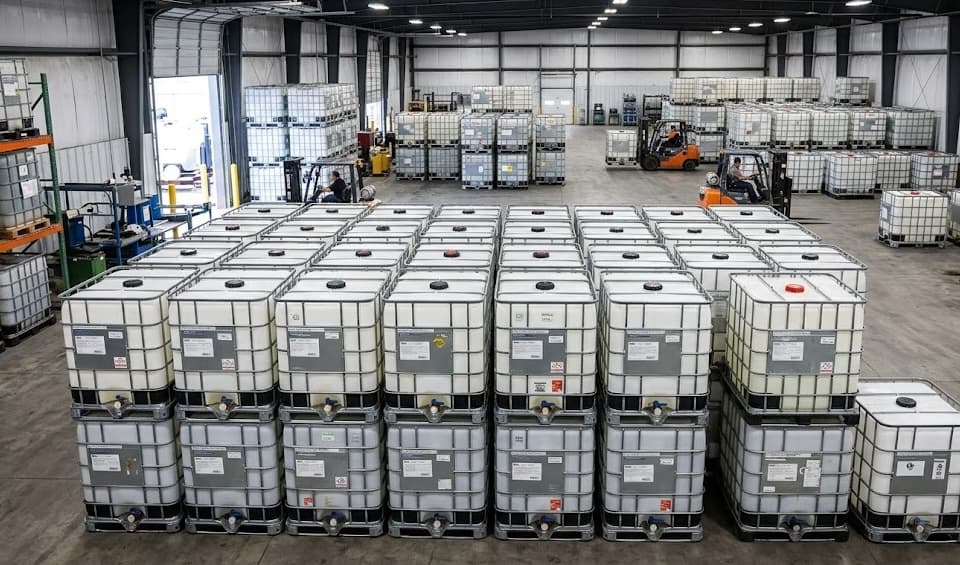
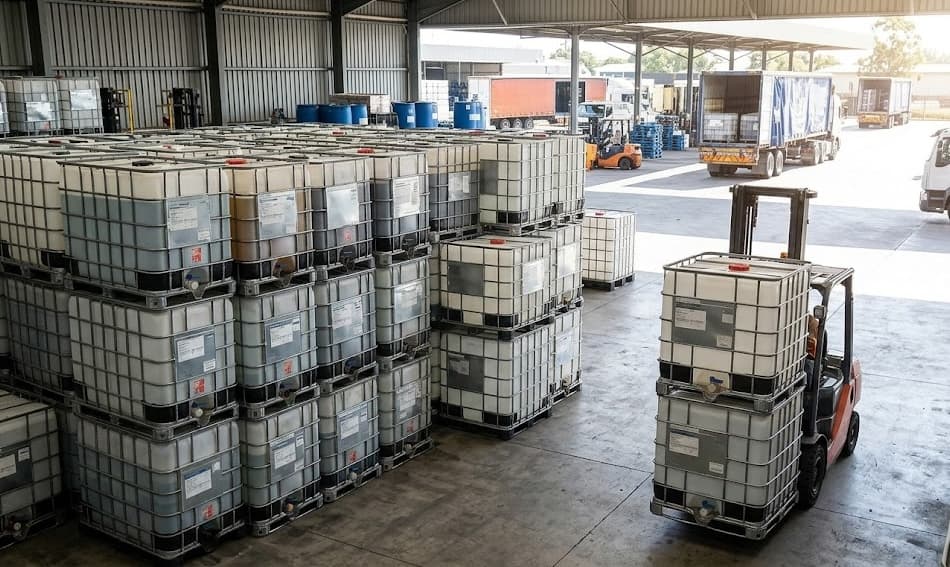
Each IBC we process is one less container in a landfill. Our zero-waste facility processes over 25,000 containers annually, diverting millions of pounds of HDPE, steel, and wood from the waste stream.
Partnerships for Greater Impact
Plastic Waste Reduction Initiatives
We collaborate with regional environmental nonprofits focused on reducing industrial plastic waste. A portion of every recycling fee supports these efforts.
Industry Standards Development
Our team participates in industry working groups developing best practices for IBC reconditioning, grading, and lifecycle tracking standards.
Community Education
We host facility tours for local schools and business groups, demonstrating how circular economy principles work in real-world industrial settings.
Supplier Sustainability Audits
We evaluate our own suppliers for environmental compliance, preferring partners who share our commitment to waste reduction and responsible operations.
Customer Sustainability Reporting
We provide customers with detailed environmental impact reports showing the carbon, water, and material savings achieved through their IBC purchases.
Research Partnerships
We work with material science researchers to explore advanced recycling technologies and new uses for recovered HDPE, steel, and wood from end-of-life IBCs.
Sustainability FAQ
What does "zero-landfill policy" actually mean?
No material from any IBC container that enters our facility is sent to a traditional landfill. Reusable containers are reconditioned and sold. End-of-life containers are disassembled and each component sent to specialized recycling streams. Trace adhesive residues go to energy-from-waste facilities. Our 2025 diversion rate was 99.8%.
How do you measure and verify your environmental claims?
Quarterly waste audits with third-party verification, annual carbon footprint assessments with an independent consulting firm, and continuous monitoring of water usage, energy consumption, and material recovery rates. All data is compiled into an annual sustainability report available on request.
Can you provide sustainability documentation for ESG reporting?
Yes. We provide detailed environmental impact reports showing specific carbon emissions avoided, water saved, and materials diverted based on actual purchases. These include methodology documentation suitable for corporate sustainability reports, ESG disclosures, and B Corp applications.
How much CO2 does reconditioning an IBC save vs buying new?
Manufacturing a new IBC generates approximately 50 kg of CO2 equivalent. Our reconditioning generates roughly 5 kg per container — a 90% reduction. For 100 reconditioned IBCs per year, that is approximately 4,500 kg (4.5 metric tons) of avoided emissions annually.
What happens to the water used in your cleaning process?
Approximately 80% is captured, filtered, treated, and reused through our closed-loop reclamation system. The remaining 20% is treated on-site through sediment filtration, chemical treatment, and UV disinfection before discharge in full compliance with EPA standards.
Are your cleaning products environmentally safe?
Yes. We use biodegradable, phosphate-free detergents that are EPA-approved for industrial cleaning. For food-grade reconditioning, we use FDA-compliant agents. All chemicals are selected for effectiveness at lower concentrations and temperatures.
What certifications does IBC Cincinnati hold?
TRUE Zero Waste Certification (Silver), food-grade IBC reconditioning certification, DOT compliance for bulk liquid container handling, and Sustainable Cincinnati Green Business Certification (Gold). We are working toward TRUE Zero Waste Gold and ISO 14001 by 2027.
How can my company reduce its packaging carbon footprint with you?
Switch from new IBCs to reconditioned containers (90% carbon reduction per unit), set up a buyback program for your used IBCs, optimize container return logistics, and use our sustainability documentation for reporting. Contact us for a free packaging sustainability assessment.
Do you offer carbon-neutral shipping?
While our fleet is not yet carbon-neutral, we offset all fleet emissions through verified carbon credit purchases. By 2028, we target 50% alt-fuel fleet, with full electrification by 2031. Every delivery today is carbon-offset.
How do you handle contaminated containers?
Containers with hazardous residues are disassembled and components evaluated individually. Steel cages can often be decontaminated and recycled. HDPE bottles with hazardous residues go to licensed hazardous waste treatment. Nothing goes to a standard landfill.
Join the Circular Economy
Every container you buy, sell, or recycle through IBC Cincinnati is a measurable step toward a more sustainable future. Let us show you the environmental and financial impact.