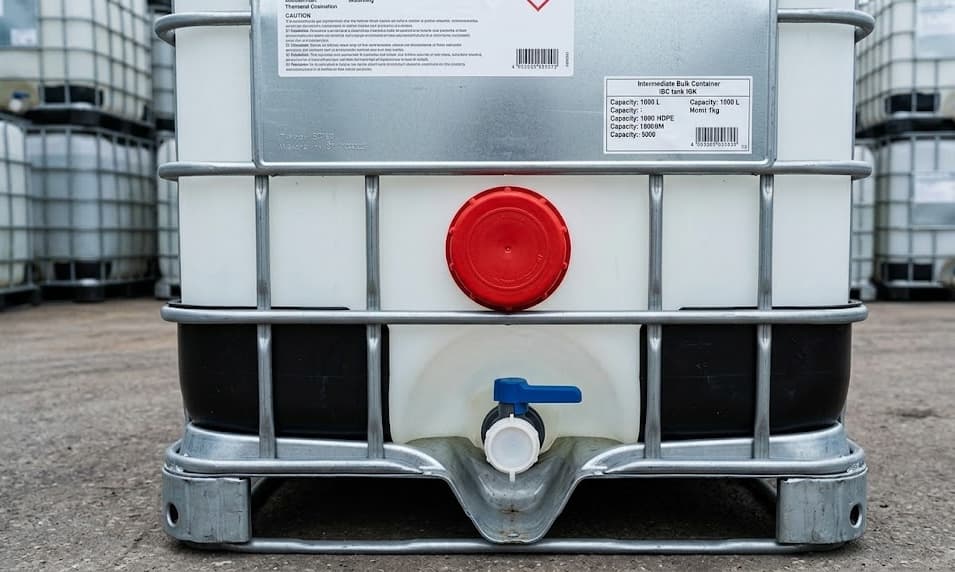
IBC Tote Size Guide
Comprehensive IBC tote size guide covering 275, 330, and 550 gallon containers. Detailed dimensions, weights, pallet types, valve sizes, and application recommendations.
Intermediate Bulk Containers (IBCs) are standardized industrial containers designed for the transport and storage of bulk liquids, granulated substances, and pastes. Choosing the right IBC size is critical for operational efficiency, regulatory compliance, and cost control. This guide covers every specification you need to make an informed decision, whether you are buying new, reconditioned, or used IBC totes from IBC Cincinnati at our facility at 1405 Worldwide Blvd, Hebron, KY 41048.
IBCs were first standardized in the early 1990s and have since become the global standard for bulk liquid handling. The three most common sizes in North America are the 275-gallon, 330-gallon, and 550-gallon models. Each serves distinct industrial purposes, and understanding their exact dimensions, weights, and fittings will help you optimize your supply chain.
Standard IBC Sizes
The 275-gallon IBC is the most common size in the United States. It fits perfectly on a standard 40" x 48" pallet and is the go-to container for food-grade applications, chemical storage, and general industrial use. Its slightly smaller footprint makes it ideal for facilities with tight loading docks or limited floor space. When full of water, it weighs approximately 2,500 lbs (1,134 kg), making it manageable for standard forklifts.
The 330-gallon IBC offers approximately 20% more capacity than the 275-gallon model while maintaining a similar footprint. This size is widely used in Europe (where it is the standard 1,000-liter IBC) and has gained significant popularity in the US for applications requiring greater volume per container. It is commonly used for agricultural chemicals, industrial solvents, and bulk food ingredients like oils and syrups.
The 550-gallon IBC is a heavy-duty, double-size container designed for operations that require maximum volume per container. It uses a larger pallet base and is best suited for stationary storage, large-scale agricultural operations, and industrial facilities with adequate floor space and heavy-duty handling equipment. Due to its weight when full (approximately 4,800 lbs), specialized forklifts or cranes are typically required.
Dimensions Comparison
| Specification | 275 Gallon | 330 Gallon | 550 Gallon |
|---|---|---|---|
| Length | 40" (1,016 mm) | 40" (1,016 mm) | 48" (1,219 mm) |
| Width | 48" (1,219 mm) | 48" (1,219 mm) | 48" (1,219 mm) |
| Height (overall) | 46" (1,168 mm) | 53" (1,346 mm) | 53" (1,346 mm) |
| Height (with pallet) | 52" (1,321 mm) | 59" (1,499 mm) | 59" (1,499 mm) |
| Capacity | 275 gal (1,040 L) | 330 gal (1,249 L) | 550 gal (2,082 L) |
| Weight (empty) | 118 lbs (54 kg) | 145 lbs (66 kg) | 250 lbs (113 kg) |
| Weight (full, water) | 2,414 lbs (1,095 kg) | 2,900 lbs (1,315 kg) | 4,845 lbs (2,198 kg) |
| Pallet footprint | 40" x 48" | 40" x 48" | 48" x 48" |
| Standard top opening | 6" (150 mm) | 6" (150 mm) | 8" (200 mm) |
Pallet Types
Wood Pallets
The most economical pallet option and the most widely available in the used IBC market. Wood pallets are typically made from hardwood and are ISPM-15 heat-treated for international shipping compliance. They are easy to repair but have a shorter lifespan than plastic or steel options. Average lifespan is 3-5 trips before replacement is needed.
- + Lowest cost
- + Easy to repair
- - Susceptible to rot and pest damage
- - Shorter lifespan
Plastic Pallets
Plastic pallets offer superior durability and are the preferred choice for food-grade and pharmaceutical applications. They are resistant to moisture, chemicals, and pests, and they do not splinter or absorb contaminants. HDPE plastic pallets can last 10+ years with proper care and are fully recyclable at end of life.
- + Hygienic and easy to clean
- + Long lifespan (10+ years)
- - Higher upfront cost
- - Harder to repair if damaged
Steel Pallets
Steel pallets are the most durable option and are commonly used with stainless steel IBCs in heavy-duty industrial applications. They can handle the heaviest loads and are resistant to virtually all chemicals. Steel pallets are fully recyclable and have the longest lifespan of any pallet type.
- + Maximum durability
- + Handles heaviest loads
- - Heaviest option (adds 30-50 lbs)
- - Highest cost
Openings & Valve Sizes
Top Openings (Fill Caps)
The top opening, also called the fill cap or lid, is where the IBC is filled. The two standard sizes are:
- 6" (150mm)The most common opening size for standard composite IBCs. Uses a screw-on cap with a gasket seal. Suitable for most liquids and granulated products. Accepts standard funnels and fill nozzles. Found on the majority of 275-gallon and 330-gallon containers.
- 8" (200mm)A wider opening used for thicker products such as pastes, slurries, and granulated materials that require faster fill rates. Common on 550-gallon containers and specialty IBCs. Also preferred when manual cleaning access is needed.
Bottom Valves (Discharge)
The bottom valve, or discharge valve, controls the outflow of contents. Standard options include:
- 2" (50mm)The standard butterfly valve size for most composite IBCs. Provides a controlled flow rate suitable for low-to-medium viscosity liquids. Uses a cam-lock or threaded connection. The 2-inch NPS (National Pipe Straight) thread is the industry standard in North America.
- 3" (75mm)A larger discharge valve for high-viscosity products, faster emptying, and applications requiring greater flow rates. Used on specialty and heavy-duty IBCs. The 3-inch valve can also be fitted with ball valves for more precise flow control.
Cage Dimensions & Materials
The cage (also called the frame or cradle) is the external steel structure that protects the inner bottle and provides structural integrity for stacking, forklift handling, and transportation. Cage specifications vary by manufacturer but generally follow these standards:
| Cage Spec | 275 / 330 Gallon | 550 Gallon |
|---|---|---|
| Material | Carbon steel (galvanized or powder-coated) | Heavy-gauge carbon steel (galvanized) |
| Wire diameter | 3/16" (4.8 mm) to 1/4" (6.4 mm) | 1/4" (6.4 mm) to 5/16" (7.9 mm) |
| Grid pattern | 3" x 3" or 4" x 4" mesh | 3" x 3" mesh (reinforced) |
| Coating | Hot-dip galvanized or electro-galvanized | Hot-dip galvanized |
| Stack weight limit | Up to 4,400 lbs (2 high when full) | Up to 6,600 lbs (2 high when full) |
When inspecting a used or reconditioned IBC, always check the cage for rust, bent wires, and loose welds. A compromised cage can reduce stacking capability and create safety hazards during transport. At IBC Cincinnati, every reconditioned container undergoes a thorough cage inspection before resale.
Which Size for Which Application?
| Application | Recommended Size | Reason |
|---|---|---|
| Food & beverage storage | 275 gal | Standard pallet fit, food-grade HDPE readily available, easiest to clean and recondition |
| Chemical distribution | 275 or 330 gal | Compatible with standard truck/trailer configurations, UN-rated options available |
| Agricultural chemicals | 330 gal | Greater capacity per container reduces handling time in field applications |
| Pharmaceutical / cosmetics | 275 gal | Tightest quality controls available, widest selection of food/pharma-grade bottles |
| Bulk stationary storage | 550 gal | Maximum volume per unit, ideal for permanent or semi-permanent installations |
| Rainwater harvesting | 275 or 330 gal | Easy to connect in series, widely available used, cost-effective for homeowners |
| Hazmat / flammables | 275 or 330 gal | UN/DOT-rated composite and stainless steel options available in these sizes |
UN Rating Explanations
United Nations (UN) ratings are internationally recognized certifications that indicate an IBC has been tested and approved for transporting hazardous materials. The UN marking is stamped on every certified container and follows a specific coding system:
UN 31HA1 — Composite IBC with Rigid Outer Packaging
The most common rating for HDPE composite IBCs. "31" means rigid IBC for liquids. "H" indicates plastic inner receptacle. "A" means rigid outer packaging (steel cage). "1" denotes a closed top. This rating is required for transporting most hazardous liquids in Packing Groups II and III.
UN 31A — Steel IBC for Liquids
Applies to all-steel IBCs. "31" means rigid IBC for liquids. "A" indicates steel construction. These containers are rated for a broader range of hazardous materials including Packing Group I substances (highest danger level).
Packing Groups (PG)
PG I — High danger (most stringent requirements, steel IBCs only). PG II — Medium danger (composite and steel IBCs). PG III — Low danger (all IBC types). The packing group determines the minimum wall thickness, drop test height, and hydrostatic pressure test requirements.
Expiration & Retest
UN-rated composite IBCs have a maximum service life of 5 years from the date of manufacture for hazmat transport. They must pass periodic inspection every 2.5 years. After 5 years, the inner bottle must be replaced or the entire unit retired from hazmat service. Non-hazmat use has no such time limit.
Metric / Imperial Conversion Table
IBC specifications are referenced in both imperial (US) and metric (international) units depending on the manufacturer and region. Use this quick-reference conversion table to translate between the two systems for all common IBC measurements.
| Measurement | Imperial | Metric | Conversion Factor |
|---|---|---|---|
| Volume | 1 US gallon | 3.785 liters | gal x 3.785 = L |
| Volume | 275 gallons | 1,040.9 liters | Standard IBC (US) |
| Volume | 330 gallons | 1,249.2 liters | Standard IBC (EU ~1,000 L) |
| Volume | 550 gallons | 2,081.8 liters | Double-size IBC |
| Length | 1 inch | 25.4 mm | in x 25.4 = mm |
| Length | 40 inches | 1,016 mm (101.6 cm) | Standard pallet width |
| Length | 48 inches | 1,219 mm (121.9 cm) | Standard pallet length |
| Weight | 1 pound (lb) | 0.4536 kg | lbs x 0.4536 = kg |
| Pressure | 1 PSI | 6.895 kPa (0.069 bar) | PSI x 6.895 = kPa |
Pro Tip: Ordering for International Shipments
When ordering IBCs for international export, always confirm whether your overseas partner expects metric or imperial sizing. European customers typically request 1,000-liter (264 gal) or 1,250-liter (330 gal) containers, while US and Canadian buyers work in gallons. Mismatched units are one of the most common causes of ordering errors in cross-border IBC procurement. IBC Cincinnati can provide documentation in both unit systems upon request.
Pallet Footprint & Loading Diagrams
Understanding how IBCs occupy floor space and fit into trucks is critical for warehouse layout planning and transportation cost optimization. The following diagrams illustrate how different IBC sizes fill standard truck and warehouse configurations.
53-Foot Dry Van Trailer Loading
| IBC Size | Pallet Footprint | Per Row (Width) | Rows Deep (Length) | Single Layer | Double Stacked (Empty) | Max Full (by Weight) |
|---|---|---|---|---|---|---|
| 275 gal | 40" x 48" | 2 across | 14 deep | 28 units | 56 units | 20-22 units |
| 330 gal | 40" x 48" | 2 across | 14 deep | 28 units | 56 units | 18-20 units |
| 550 gal | 48" x 48" | 2 across | 13 deep | 26 units | 52 units | 10-12 units |
Warehouse Floor Space per IBC
| IBC Size | Floor Area (sq ft) | Floor Area (sq m) | IBCs per 1,000 sq ft | IBCs per 100 sq m |
|---|---|---|---|---|
| 275 gal | 13.3 sq ft | 1.24 sq m | ~75 (single layer) | ~80 (single layer) |
| 330 gal | 13.3 sq ft | 1.24 sq m | ~75 (single layer) | ~80 (single layer) |
| 550 gal | 16.0 sq ft | 1.49 sq m | ~62 (single layer) | ~67 (single layer) |
These figures assume tight packing without aisle space. In practice, account for 30-40% additional space for forklift aisles (minimum 12-foot aisle width for standard forklifts). For help optimizing your warehouse layout for IBC storage, contact our team.
Did You Know?
The 40" x 48" pallet footprint used by 275-gallon and 330-gallon IBCs is the GMA (Grocery Manufacturers Association) standard pallet size, which accounts for approximately 30% of all pallets produced in North America. This means your existing pallet racking, forklifts, and dock equipment are almost certainly already compatible with standard IBC totes. The 48" x 48" footprint of the 550-gallon IBC is the second most common pallet size in the US, used extensively in the chemical and petroleum industries.
Stackability Charts & Guidelines
Proper stacking maximizes vertical storage space and is essential for efficient warehousing and transportation. However, improper stacking is one of the leading causes of IBC accidents. Use this chart to determine safe stacking limits for your containers.
| Condition | 275 gal Max Stack | 330 gal Max Stack | 550 gal Max Stack | Total Height (approx) |
|---|---|---|---|---|
| Full containers (new cage) | 2 high | 2 high | 2 high | 104" / 118" / 118" |
| Full containers (used cage, good condition) | 2 high | 2 high | 1 only | 104" / 118" / 59" |
| Full containers (damaged cage) | DO NOT STACK | DO NOT STACK | DO NOT STACK | N/A |
| Empty containers (good cage) | 3 high | 3 high | 2 high | 156" / 177" / 118" |
| In-transit (DOT compliant) | 2 high (secured) | 2 high (secured) | 1 only | Must fit trailer height |
Stacking Safety Checklist
- 1. Verify all four cage corners are square and undamaged before stacking.
- 2. Ensure the lower container's top frame is level and flat — a warped top frame creates an unstable platform.
- 3. Match IBC sizes when stacking — never stack a 550-gallon on top of a 275-gallon container.
- 4. Confirm the pallet of the upper container seats fully on the cage corners of the lower container.
- 5. Never stack IBCs containing incompatible chemicals directly above each other.
- 6. Use forklift access from the pallet side only — never lift IBCs by the cage wires.
Weight Distribution Guidelines
Understanding how weight is distributed within an IBC is critical for safe handling, transportation, and storage. The center of gravity shifts depending on fill level, liquid density, and pallet type, which directly impacts forklift stability and stacking safety.
| Product Type | Specific Gravity | 275 gal Weight (full) | 330 gal Weight (full) | 550 gal Weight (full) |
|---|---|---|---|---|
| Water | 1.00 | 2,414 lbs | 2,900 lbs | 4,845 lbs |
| Vegetable oil | 0.92 | 2,230 lbs | 2,680 lbs | 4,475 lbs |
| Corn syrup | 1.38 | 3,290 lbs | 3,950 lbs | 6,600 lbs |
| Sulfuric acid (93%) | 1.83 | 4,330 lbs | 5,200 lbs | 8,690 lbs |
| Ethanol | 0.79 | 1,930 lbs | 2,320 lbs | 3,870 lbs |
| Sodium hydroxide (50%) | 1.52 | 3,610 lbs | 4,335 lbs | 7,240 lbs |
Warning: Heavy Liquids
Products with a specific gravity above 1.5 (such as concentrated acids, caustic solutions, and heavy syrups) significantly increase the gross weight of a full IBC. A 275-gallon IBC filled with sulfuric acid weighs over 4,300 lbs — nearly twice the weight of the same container filled with water. Always verify that your forklift, pallet racking, and floor load capacity can handle the actual weight of your product, not just the weight of water.
Center of Gravity Considerations
- - A full IBC has its center of gravity approximately 24-26 inches above the floor (for 275 gal) or 28-30 inches (for 330 gal).
- - A half-full IBC has a lower center of gravity but is more prone to liquid sloshing, which creates dynamic load shifts during forklift transport.
- - Always transport IBCs with forks fully inserted under the pallet and tilted slightly back to keep the center of gravity over the forklift's wheelbase.
- - Travel speed should be reduced when carrying full IBCs, especially on inclines or uneven surfaces.
Forklift Compatibility Guide
Not every forklift can safely handle every IBC size and weight. This compatibility chart helps you determine whether your existing material handling equipment is rated for the IBC configurations you plan to use.
| Forklift Type | Typical Capacity | 275 gal (Water) | 330 gal (Water) | 550 gal (Water) | Fork Length Needed |
|---|---|---|---|---|---|
| Pallet jack (manual) | 5,000 lbs | OK (flat ground only) | OK (flat ground only) | Too heavy | 48" standard |
| Electric walkie stacker | 3,000-4,000 lbs | OK | OK (verify capacity) | Not recommended | 48" standard |
| Class I electric sit-down | 4,000-6,000 lbs | OK | OK | OK (with 6K+ capacity) | 42-48" |
| Class IV/V IC cushion/pneumatic | 5,000-8,000 lbs | OK | OK | OK | 42-48" |
| Heavy-duty (8,000+ lbs) | 8,000-15,000 lbs | OK | OK | OK (required for heavy liquids) | 48-60" |
Pro Tip: Fork Length Matters
Standard forklift forks are typically 42 inches long, which is sufficient for entering 275-gallon and 330-gallon IBC pallets from the 40-inch side. However, if you need to approach from the 48-inch side, or if you handle 550-gallon IBCs with 48" x 48" pallets, you will need 48-inch forks. Always ensure forks are fully inserted before lifting — partial fork insertion creates a tipping hazard. At IBC Cincinnati, we can advise you on the best handling approach for your specific equipment setup.
Size Guide FAQ
Can I use a 275-gallon IBC where a 330-gallon is specified?+
What is the maximum fill level for an IBC?+
Are IBC dimensions standardized across all manufacturers?+
How do I measure the remaining volume in a partially filled IBC?+
Can a 550-gallon IBC fit through a standard doorway?+
Need Help Choosing the Right IBC Size?
Our team at IBC Cincinnati has decades of combined experience with intermediate bulk containers. Contact us for personalized recommendations based on your specific application, volume requirements, and budget.