Landfill Diversion
Every IBC we recycle keeps approximately 240 lbs of mixed material out of landfills. Over a year, that adds up to more than 1,400 tons of diverted waste.
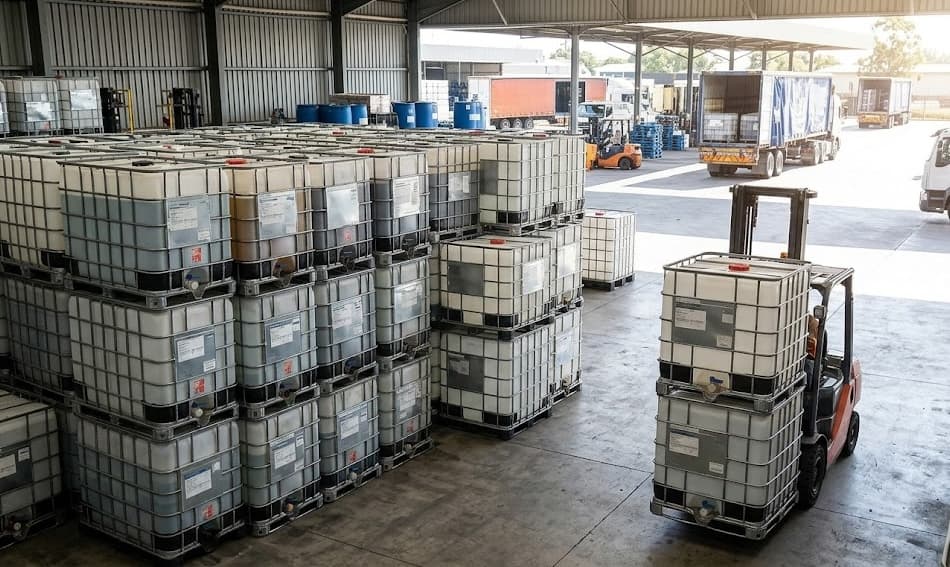
Zero-waste IBC processing: HDPE granulation, steel reclamation, pallet recovery. Every component recycled responsibly.
12,000+
IBCs Recycled Annually
98%
Material Recovery Rate
450+
Tons of Plastic Diverted from Landfills
600+
Tons of Steel Reclaimed per Year
An intermediate bulk container is a marvel of material engineering — roughly 130 pounds of high-density polyethylene, 70 pounds of galvanized steel, and a 40-pound hardwood pallet, all designed to safely transport 275 gallons of liquid. When an IBC reaches the end of its useful life, throwing it in a landfill means burying nearly 240 pounds of perfectly recyclable material. Multiply that by the millions of IBCs retired each year across the United States, and the waste problem becomes staggering.
At IBC Cincinnati, we believe that every material in a retired tote has economic and environmental value. Our recycling facility at 1405 Worldwide Blvd, Hebron, KY 41048 is purpose-built for container disassembly and material recovery. We achieve a 98% material recovery rate, meaning virtually nothing from an IBC we process ends up in a landfill.
For businesses under EPA, OSHA, or DOT regulation, our documented chain-of-custody process and Certificate of Destruction program provide the audit trail you need for compliance. We handle containers that previously held hazardous materials, pesticides, pharmaceuticals, and other regulated substances — all processed according to federal and state environmental standards.
Each IBC is composed of three primary materials. Here is a detailed breakdown of what happens to each component and the recovery rates we achieve.
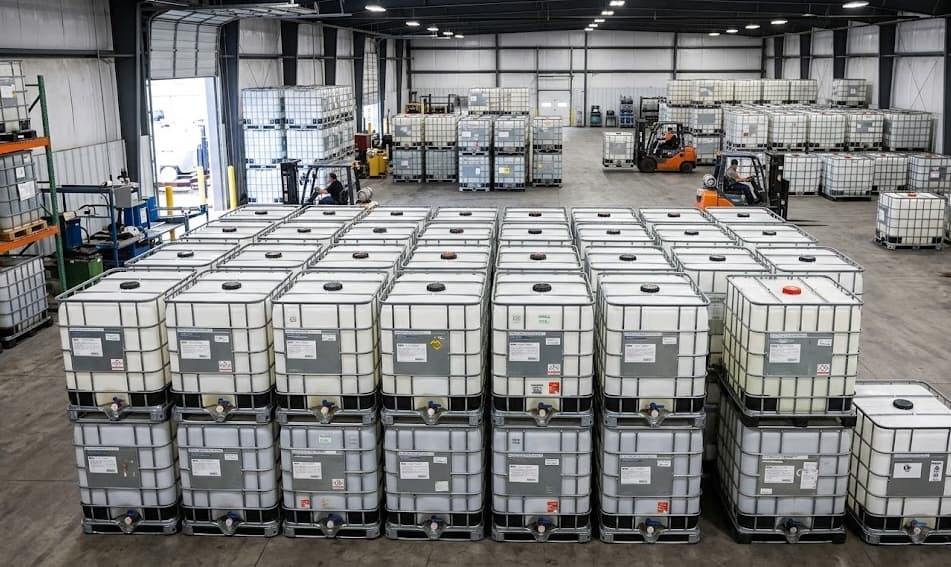
Every component of every IBC is either reused or recycled. Our 98% material recovery rate means virtually nothing ends up in a landfill.
99%
Recovery Rate
The 130-lb HDPE inner bottle is our primary recovery target. After removal from the cage, each bottle is thoroughly washed to remove chemical residue, then fed through industrial shredders that reduce it to flake. The flake is further processed into uniform regrind pellets.
End products: Drainage pipe, plastic lumber, storage bins, automotive underbody components, irrigation tubing, and new container components.
Recovery loss: Less than 1% is lost to washing residue and contaminated fragments that cannot meet resin quality standards.
99.5%
Recovery Rate
The 70-lb steel cage frame is infinitely recyclable. We separate cages from bottles, remove any non-metal attachments (labels, plastic clips), and compact the steel for efficient transport to regional metal recyclers.
End products: Structural steel, rebar, automotive sheet metal, appliances, new cage frames, and construction materials.
Recovery loss: Negligible — steel recycling is one of the most efficient material recovery processes in existence. Only trace amounts of galvanizing residue and scale are lost.
95%
Recovery Rate
Usable wood pallets (approximately 40% of incoming units) are repaired and resold into the pallet market. Damaged wood pallets are chipped for secondary use. Plastic pallets are granulated alongside HDPE bottles.
End products (wood): Repaired pallets, biomass fuel, landscaping mulch, animal bedding, particle board, and compost feedstock.
Recovery loss: Approximately 5% of wood mass is lost to sawdust, nails, and fragments that fall below minimum chip size for processing.
Valves & Fittings
Functional valves are cleaned and resold as replacement parts. Non-functional ones are sorted by material (brass, polypropylene, stainless steel) and recycled accordingly.
Gaskets & Seals
EPDM and PTFE gaskets are collected and recycled through specialized rubber/polymer processing. Weight is minimal but contributes to our zero-waste target.
Labels & Adhesives
Paper labels are pulped. Adhesive residue is captured during the HDPE washing process and filtered from wastewater for proper disposal.
From pickup to certification, here is exactly how we transform end-of-life containers into valuable raw materials.
We pick up end-of-life IBCs from your facility or accept drop-offs at our Hebron, KY location. Every container is logged, photographed, and assigned a tracking number for full chain-of-custody documentation.
Each container is assessed to determine whether it can be reconditioned for reuse or should proceed to recycling. Totes with reuse potential are diverted to our cleaning program — maximizing the lifecycle of every unit before it enters the recycling stream.
IBCs are broken down into their three core components: the HDPE plastic inner bottle, the galvanized or painted steel cage, and the wood or plastic pallet base. This manual and mechanical separation ensures each material stream remains uncontaminated.
The polyethylene bottles are shredded, washed, and granulated into HDPE regrind pellets. This recycled resin is sold to manufacturers who use it to produce drainage pipe, plastic lumber, containers, and automotive components — giving the material a productive second life.
Galvanized steel cages are compacted and sent to regional metal recyclers where they are melted down and reformed into new steel products. Steel is infinitely recyclable, so every cage we process becomes raw material for construction, appliances, or new industrial equipment.
Wood pallets in usable condition are repaired and resold. Broken pallets are chipped into biomass fuel, landscaping mulch, or animal bedding. Plastic pallets are granulated alongside the HDPE bottles. Nothing is wasted.
You receive a Certificate of Recycling (or Certificate of Destruction for regulated industries) confirming that your containers were processed in full compliance with federal and state environmental regulations.
Industries that handle hazardous, pharmaceutical, or EPA-regulated materials require a higher standard of recycling documentation and process control. Here is how we serve those needs.
IBCs that held industrial chemicals, solvents, acids, or bases require specialized handling. We triple-rinse containers before dismantling to capture and properly dispose of residual chemicals. Rinse water is treated through our wastewater filtration system before discharge. All processing complies with RCRA (Resource Conservation and Recovery Act) requirements.
You receive a Certificate of Destruction documenting the container serial numbers, previous contents, decontamination method, and final disposition of all materials.
Containers that held active pharmaceutical ingredients (APIs), excipients, or biotech process fluids are handled under strict protocols to prevent cross-contamination and ensure regulatory compliance. We coordinate with your quality and regulatory teams to meet FDA and DEA requirements where applicable.
For Schedule II–V substances, we provide DEA-compatible destruction records. All labels and identifying information are removed and documented as part of our de-identification process.
Pesticide containers are regulated under FIFRA (Federal Insecticide, Fungicide, and Rodenticide Act) and require proper triple-rinsing and processing. We follow EPA guidelines for pesticide container disposal and can accept both refillable and non-refillable IBC configurations.
Agricultural co-ops and chemical applicators benefit from our scheduled pickup service for seasonal container accumulation after application seasons.
Containers used for petroleum products, lubricants, hydraulic fluids, and fuel additives are processed through our hydrocarbon decontamination line. Residual petroleum products are captured and sent to licensed waste oil recyclers.
We work with oilfield service companies, refineries, and fleet maintenance operations throughout the Midwest to provide compliant recycling with full documentation.
Our documentation system provides an unbroken record from the moment we collect your containers to the final disposition of every material component. Here is what we track and provide.
Issued at your facility during collection. Documents the number of containers, their approximate condition, your company information, and the driver/vehicle responsible for transport.
Each container is photographed upon arrival at our facility and logged into our tracking system with a unique ID number tied to your account and pickup order.
Documents whether each container was routed to reconditioning, parts harvesting, or recycling — with the specific reason for the disposition decision.
Details the decontamination method used, rinse water test results, and confirmation that residual contamination levels fall below regulatory thresholds.
Receipts from downstream recycling partners confirming that HDPE regrind, scrap steel, and wood chips were accepted into their recycling streams.
The final summary document issued to you. Confirms that all containers in your lot were processed in compliance with applicable federal and state regulations. Includes container counts, dates, methods, and our facility permit information.
All documentation is provided digitally (PDF) and can be mailed in hard copy upon request. Records are retained for a minimum of 7 years in compliance with EPA record-keeping requirements.
Issued for standard (non-hazmat) IBC totes. Confirms that your containers were dismantled and each material component was recycled through certified downstream partners.
Suitable for: General industrial, food & beverage, agriculture, construction
Issued for containers that held regulated, hazardous, or branded materials requiring verified destruction. Includes decontamination details and material disposition records.
Suitable for: Chemical, pharmaceutical, pesticide, petroleum industries
A quantified environmental impact report detailing the tonnage of material diverted from landfill, estimated carbon savings, water conservation figures, and energy savings attributable to your recycled containers.
Suitable for: Corporate sustainability reports, ESG disclosures, annual reports
Every IBC we recycle keeps approximately 240 lbs of mixed material out of landfills. Over a year, that adds up to more than 1,400 tons of diverted waste.
Recycling HDPE uses 88% less energy than producing virgin polyethylene from petroleum. Recycling steel saves 74% of the energy needed for primary production.
Manufacturing new HDPE from raw petroleum requires significant water resources. Recycling our HDPE bottles reduces water consumption by an estimated 60% per ton.
Our recycled HDPE regrind enters the manufacturing supply chain to become new products — drainage pipe, plastic lumber, bins — completing the circular economy loop.
Containers that held regulated chemicals are properly decontaminated and neutralized before material processing, preventing soil and groundwater contamination.
Companies that recycle their IBCs through certified facilities can report quantifiable environmental impact in CSR and ESG disclosures.
“The Certificate of Destruction documentation from IBC Cincinnati saved us during our last EPA audit. Every container was tracked from our loading dock to final material disposition. The level of detail is exactly what regulated industries need.”
“We recycle over 500 IBCs per year through IBC Cincinnati. Their ESG impact statements go directly into our annual sustainability report. The quantified data on landfill diversion and carbon savings has been invaluable for our corporate responsibility program.”
“As a pharmaceutical company, we needed a recycling partner that understood DEA requirements for container destruction. IBC Cincinnati provided compliant certificates for every batch and made the entire process effortless.”
Our recycling operations are conducted in full compliance with EPA regulations, RCRA guidelines, and applicable state environmental laws in Kentucky and Ohio. We carry all required permits for the handling and processing of industrial containers, including those that previously held hazardous materials.
We offer scheduled and on-demand pickup for end-of-life IBCs. Whether you have a dozen containers or an entire warehouse to clear, we handle the logistics so you can focus on your core business.
Schedule a Recycling PickupNot sure whether to sell your IBCs for reuse or recycle them? Here is a comparison to help you decide. In many cases, we make the determination for you during our assessment process.
| Factor | Sell for Reuse | Recycle |
|---|---|---|
| Container Condition | Good — structurally sound, cleanable | Any — damaged, expired, or contaminated OK |
| Payout | Higher — based on resale value | Lower — based on material value |
| Documentation | Bill of sale | Certificate of Recycling or Destruction |
| Best For | Clean, intact totes with remaining useful life | End-of-life, hazmat, or heavily damaged containers |
| Environmental Impact | Extends container lifecycle | Recovers raw materials for new products |
| Turnaround | Payment on pickup day | Payment on pickup day + certificate within 7 days |
Most of our clients let us make the call. We always prioritize reuse over recycling — containers that can serve another lifecycle are cleaned and reconditioned first. Only truly end-of-life units enter the recycling stream. You can also sell your IBCs to us and we will determine the best path for each container.
Contact us to arrange a recycling pickup or learn more about our zero-waste processing program. We will provide a free assessment and recycling plan for your containers.
We respond to every inquiry within 24 hours