Unique Serial Number
Every IBC receives a unique serial number at intake, printed on a weather-resistant label attached to the cage. This number links to the complete digital record of that container.
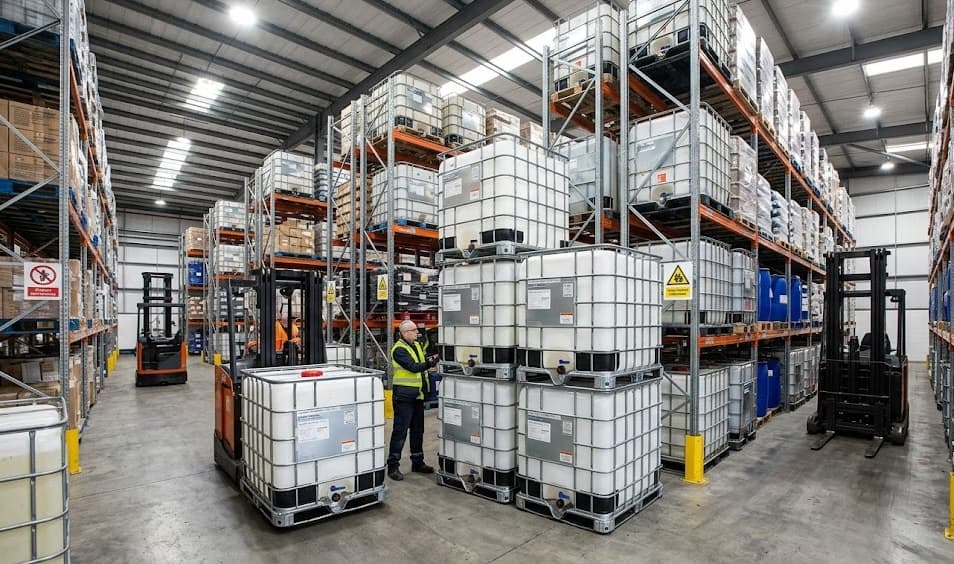
The more containers you need, the more you save. IBC Cincinnati offers structured volume pricing, dedicated account management, and full fleet management services.
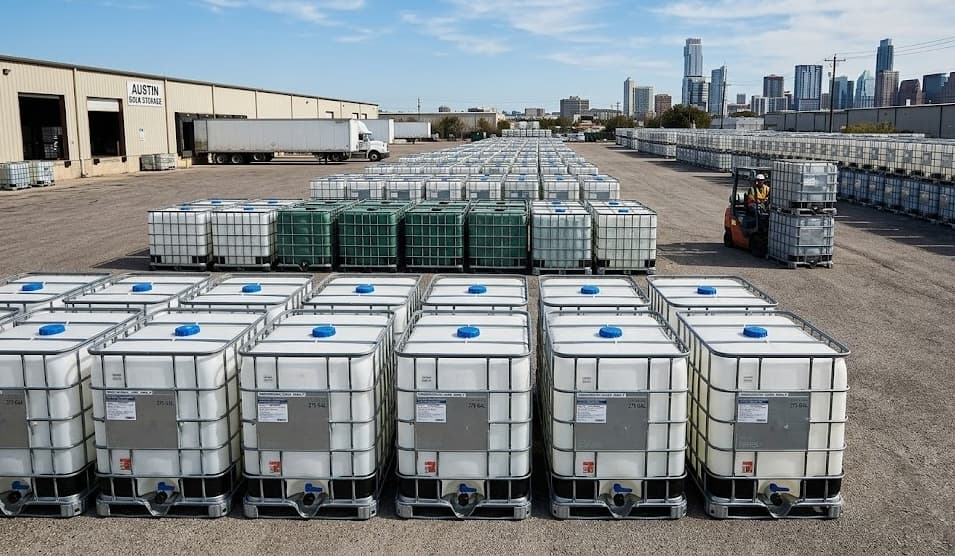
Our tiered pricing structure rewards larger orders with progressively deeper discounts. All discounts are calculated off standard single-unit pricing and apply to used, reconditioned, and new IBC totes.
| Quantity | Discount | Included Benefits |
|---|---|---|
| 10 – 49 | 10%off list | Standard volume discount, free delivery within 100 miles, 48-hour fulfillment guarantee. |
| 50 – 99 | 18%off list | Enhanced volume discount, priority inventory access, dedicated account coordinator, free delivery within 200 miles. |
| 100 – 499 | 25%off list | Major volume discount, dedicated account manager, scheduled recurring delivery, custom labeling at no extra charge, priority reconditioning queue. |
| 500+ | 35%+off list | Enterprise pricing negotiated per contract, consignment inventory options, fleet management program, branded containers, quarterly business reviews. |
Standard volume discount, free delivery within 100 miles, 48-hour fulfillment guarantee.
Enhanced volume discount, priority inventory access, dedicated account coordinator, free delivery within 200 miles.
Major volume discount, dedicated account manager, scheduled recurring delivery, custom labeling at no extra charge, priority reconditioning queue.
Most PopularEnterprise pricing negotiated per contract, consignment inventory options, fleet management program, branded containers, quarterly business reviews.
Discounts apply to all container types. Custom pricing available for multi-year contracts and enterprise volumes exceeding 1,000 units per month.
Proper logistics planning is the key to maximizing the value of your bulk IBC program. Use this guide to optimize your delivery schedules, storage capacity, and transportation costs.
| Shipment Type | Max IBCs per Load | Avg. Cost per IBC (Shipping) | Best For | Transit Time (from Hebron) |
|---|---|---|---|---|
| Full Truckload (FTL) — 53' Dry Van | 56 IBCs | $8 - $15 | Orders of 50+ units, lowest per-unit cost | 1-3 days (500mi radius) |
| Full Truckload (FTL) — Flatbed | 48 IBCs | $10 - $18 | Oversized loads, multi-drop deliveries | 1-3 days (500mi radius) |
| Less-Than-Truckload (LTL) | 1 - 24 IBCs | $25 - $60 | Smaller orders, budget-conscious | 2-5 days |
| Dedicated Fleet (IBC Cincinnati) | 30 IBCs | $12 - $20 | Local/regional, flexible scheduling | Same-day to next-day (200mi) |
| Customer Pickup | Unlimited | $0 | Maximum savings, nearby customers | Immediate (Mon-Fri, 7AM-5PM) |
| Expedited / Hot Shot | 1 - 12 IBCs | $50 - $120 | Emergencies, production line shortages | Same-day (100mi radius) |
Pro Tip: The optimal bulk order size for shipping efficiency is 56 units (one full truckload in a 53-foot dry van). Ordering in multiples of 56 minimizes your per-unit shipping cost. If your monthly consumption does not align with full truckloads, consider consolidating orders or using our scheduled delivery program to batch shipments efficiently.
Effective IBC inventory management reduces waste, prevents stockouts, and optimizes your container spending. Follow these 12 best practices used by our most successful bulk customers.
Implement FIFO (First In, First Out) rotation to ensure oldest containers are used first, preventing age-related degradation
Maintain a safety stock of 15-20% above your average monthly consumption to buffer against demand spikes and supply delays
Designate separate staging areas for empty, filled, and return-ready containers to prevent mix-ups and improve warehouse flow
Track container lifecycle using serial numbers — know each IBC's age, fill count, and reconditioning history
Schedule reconditioning returns in batches of 20+ to qualify for free pickup and maximize logistics efficiency
Conduct monthly physical counts of your IBC inventory and reconcile against your tracking system — discrepancies signal losses or misplacement
Implement color-coded valve caps or labels for different product lines to prevent cross-contamination and simplify warehouse operations
Set automated reorder triggers at 30% remaining inventory to allow for lead time without emergency ordering premiums
Store empty IBCs stacked no more than 3 high to prevent structural damage and maintain safe working conditions
Inspect all incoming containers upon delivery — document condition, verify count, and check certifications before acceptance
Create a damaged container quarantine zone — do not mix damaged IBCs with operational inventory to avoid accidental use
Review your container consumption data quarterly with your IBC Cincinnati account manager to identify optimization opportunities and adjust order quantities
The purchase price of an IBC is only a fraction of the total cost. A comprehensive TCO analysis includes acquisition, maintenance, logistics, storage, and disposal costs over the entire container lifecycle. Here is how different procurement strategies compare.
| Cost Component | New IBC (Buy) | Reconditioned (Buy) | Fleet Program (Lease) |
|---|---|---|---|
| Acquisition Cost (per unit) | $350 | $150 | $0 upfront |
| Per-Use Cost (per fill cycle) | $58 | $38 | $25 |
| Maintenance & Cleaning | $0 (new) | $0 (included) | $0 (included) |
| Storage Costs (annual, per unit) | $12 - $24 | $12 - $24 | $0 (just-in-time) |
| Disposal/Recycling Cost | $15 - $40 | $0 (buyback) | $0 (included) |
| Damage & Loss (avg. 5%) | $17.50 | $7.50 | $0 (IBC Cinci risk) |
| Administrative Overhead | High (procurement, tracking) | Medium | Low (managed service) |
| Total 5-Year TCO (per unit) | $452 | $182 | $150 |
| TCO Savings vs. New | Baseline | 60% | 67% |
Did You Know? Our fleet program customers see an average 67% reduction in total cost of ownership compared to buying new IBCs. The fleet model eliminates acquisition costs, disposal fees, storage overhead, and administrative burden — you pay only for the container uses you need. Use our IBC Savings Calculator to model your specific TCO.
A well-planned fleet rotation ensures you always have clean containers ready while minimizing idle inventory. Below is a sample rotation schedule for a mid-size operation consuming 200 IBCs per month.
| Week | Clean IBCs Delivered | Used IBCs Picked Up | In Reconditioning | On-Site Inventory | Status |
|---|---|---|---|---|---|
| Week 1 | 50 | 0 | 0 | 50 | Initial delivery |
| Week 2 | 50 | 25 | 25 | 75 | Building buffer |
| Week 3 | 50 | 50 | 50 | 75 | Steady state begins |
| Week 4 | 50 | 50 | 50 | 75 | Full rotation active |
| Week 5+ | 50 | 50 | 50 | 75 | Ongoing — 75 buffer maintained |
| Peak Season | 75 | 50 | 75 | 100 | Scaled up with 48hr notice |
Pro Tip: Maintain a buffer stock equal to 1.5 weeks of consumption (approximately 37% of your monthly volume). This cushion absorbs demand fluctuations and delivery timing variations without requiring emergency orders. Your IBC Cincinnati account manager will customize a rotation schedule based on your exact consumption patterns.
Every IBC in our fleet and bulk programs is tracked through its complete lifecycle using our container management system. Here is what gets tracked and why it matters for your operation.
Every IBC receives a unique serial number at intake, printed on a weather-resistant label attached to the cage. This number links to the complete digital record of that container.
Every product that has been stored in each container is documented. This is critical for food-grade applications, allergen tracking, and chemical compatibility verification.
We track how many times each container has been filled and reconditioned. This data drives lifecycle forecasting and replacement planning.
Cleaning protocols, wash temperatures, sanitizer concentrations, operator IDs, and pass/fail inspection results — all recorded per container per cycle.
Full logistics tracking shows when each container was delivered to your facility and when it was picked up for return. This data helps optimize rotation schedules.
At every intake, containers are graded on a standardized scale (A/B/C/Scrap) for bottle condition, cage integrity, valve function, and pallet soundness.
FDA compliance, UN/DOT certification, kosher/halal documentation, and cleaning validation records are all linked to the container serial number for instant retrieval.
Quarterly fleet reports show your container utilization rate, idle inventory percentage, average turn time, and cost-per-use metrics.
When a container reaches end of life, recycling or disposal is documented with Certificates of Recycling or Destruction linked to the serial number.
Did You Know? Fleet program customers report a 23% reduction in container losses and a 15% improvement in utilization rates after implementing our serial-number tracking system. The data visibility alone pays for itself through reduced waste and better inventory decisions.
Volume pricing is just the beginning. Our bulk programs include a full suite of services designed to simplify your container management and reduce operational overhead.
Every bulk customer is assigned a dedicated account manager who knows your container specifications, delivery schedule, and operational preferences. No call centers, no ticket systems — you get a direct phone line and email to someone who understands your business. Your account manager proactively monitors your inventory levels, alerts you to supply availability, and coordinates every delivery to keep your operations running without interruption.
For businesses with predictable container consumption, our scheduled delivery program eliminates the need to place repeat orders. We work with you to establish a delivery cadence — weekly, biweekly, or monthly — and automatically prepare and ship your containers on the agreed schedule. Delivery quantities can be adjusted with 48 hours notice, and seasonal volume fluctuations are built into your program plan so you never face a shortage during peak periods.
Bulk customers at the 100+ unit tier receive custom labeling at no additional charge. We apply your company logo, product identification, handling instructions, hazard markings, and barcodes directly to the IBC bottle and cage using industrial-grade weather-resistant labels. For enterprise customers ordering 500+ units, we offer embossed branding on the HDPE bottle and color-coded containers for product-line identification across your facility.
Our fleet management program tracks every container in your rotation. Each IBC is assigned a unique serial number and logged in our tracking system with fill date, contents, delivery date, return date, and reconditioning cycle. You receive quarterly fleet reports showing container utilization rates, average lifecycle, and replacement forecasts. This visibility helps you optimize your container inventory, reduce idle stock, and plan capital expenditures with precision.
For qualifying enterprise customers, we offer consignment inventory — IBC totes stored at your facility but owned by IBC Cincinnati until you fill and use them. You pay only for containers as you consume them, reducing your upfront capital outlay and eliminating the risk of overstock. Consignment inventory is replenished automatically based on your usage patterns, and our team conducts quarterly physical counts to reconcile inventory levels.
Bulk customers benefit from our closed-loop container program. When you empty a batch of IBCs, we pick them up, recondition them to your required specification, and return them ready for the next fill cycle. This dramatically reduces your per-use container cost compared to one-way purchasing and supports your sustainability goals by extending container lifecycle by 5 to 10 refill cycles before retirement to recycling.
Contact us with your container type, grade, quantity, and delivery schedule. Our team will assess your needs and recommend the right program tier.
Within 24 hours, your dedicated account manager will deliver a detailed quote including volume pricing, delivery costs, and any custom services like labeling or fleet tracking.
Once you approve the quote, we lock in your pricing, reserve inventory, and build your delivery schedule. First shipments typically go out within 48 hours of confirmation.
Your account manager monitors your program, adjusts volumes as needed, coordinates returns for reconditioning, and provides quarterly reports on usage, costs, and sustainability metrics.
3,000+
IBCs in Rotating Inventory
48hr
Average Fulfillment Time
35%
Max Volume Discount
500+
Active Bulk Customers
Bulk pricing begins at 10 units per order. At 10-49 units you receive a 10% discount; at 50-99 units, 18% off; at 100-499, 25% off; and at 500+ units, 35% or more. There is no minimum commitment period — you can place a single bulk order or set up a recurring program.
Yes. You can combine new, reconditioned, and used IBCs in a single order and still qualify for volume pricing based on the total unit count. You can also mix 275-gallon and 330-gallon sizes, food-grade and industrial-grade, and different valve configurations.
In our fleet program, IBC Cincinnati owns and manages the containers. We deliver clean IBCs to your facility on a regular schedule, pick up empties, recondition them, and return them. You pay a per-use fee that covers everything: containers, delivery, pickup, cleaning, and eventual recycling. You never buy, maintain, or dispose of a single IBC — we handle the entire lifecycle.
Our programs are flexible by design. You can increase or decrease your order volume with 48 hours notice for scheduled deliveries. There are no penalties for volume changes. Seasonal fluctuations are expected and built into every program plan. Your account manager will proactively discuss volume adjustments as your business patterns change.
Yes. Qualified bulk customers receive Net 30 payment terms. Enterprise customers (500+ units/month) may qualify for Net 45 or Net 60 terms. We also offer consignment inventory for qualifying customers, where you pay only for containers as you use them — eliminating the need for large upfront purchases.
Every bulk customer receives quarterly fleet reports showing total containers delivered, returned, in reconditioning, and currently at your facility. Reports include cost-per-use metrics, utilization rates, lifecycle data, and sustainability metrics (material diverted from landfill, CO2 savings). Your account manager reviews these reports with you to identify optimization opportunities.
Model your exact cost savings based on volume, container type, and usage patterns.
See delivery times and coverage for your location across our 8-state service area.
Find industry-specific container solutions for food, chemical, pharma, agriculture, and more.
See real results from bulk customers who reduced costs by 50-65% with IBC Cincinnati.
Same-day rush orders when your bulk supply runs short unexpectedly.
Review our FDA, ISO, UN/DOT, and religious certifications for compliance-critical orders.
Tell us your quantity, schedule, and container specifications. We will build a custom bulk program that saves you money and simplifies your container logistics.
We respond to every inquiry within 24 hours