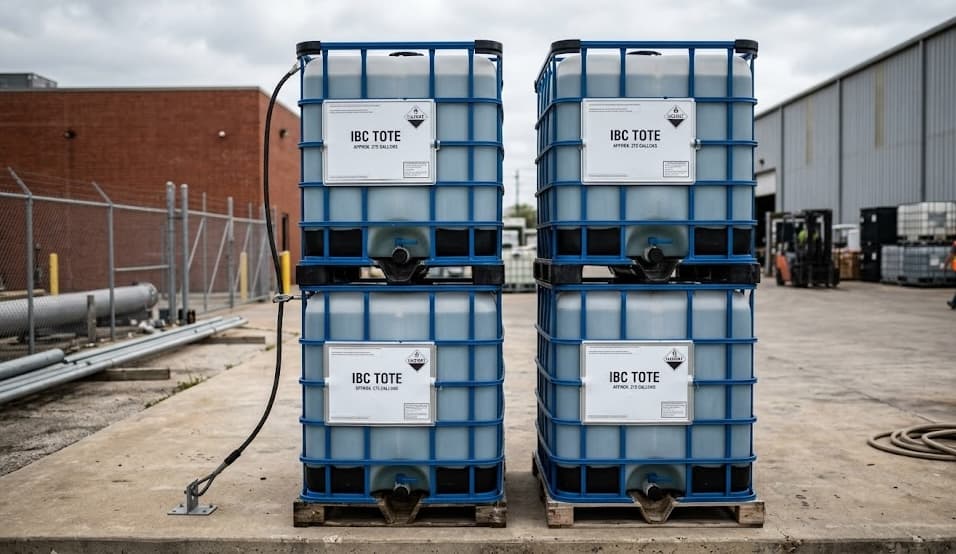
275-Gallon IBC Totes
The 275-gallon IBC is the most widely used intermediate bulk container size in North America. Its compact footprint, universal pallet compatibility, and efficient stacking geometry make it the default choice.
Dimensions & Specifications
Physical Dimensions
Construction Details
Common Applications
The 275-gallon IBC is the workhorse of the liquid container world. Its standard pallet footprint means it integrates seamlessly with existing warehousing, trucking, and handling infrastructure. Here are the industries and use cases where this size excels:
Pricing Information
275-gallon IBC pricing depends on condition (used Grade A/B/C, reconditioned, or new), order quantity, and delivery requirements. Used Grade A units typically cost 40-60% less than a brand-new container, while reconditioned units sit in between — offering near-new quality at a significant savings. Volume discounts kick in at 10 units and become increasingly aggressive at 25, 50, and full truckload quantities (typically 56 units per 53-foot trailer).
We do not publish fixed prices because market conditions, material costs, and supply fluctuate. Instead, we provide custom quotes within 24 hours that reflect real-time availability and your specific requirements. Contact us for a detailed, no-obligation quote.
Detailed Dimension Breakdown
Understanding the exact measurements of a 275-gallon IBC is critical for warehouse planning, truck loading, racking system compatibility, and spill containment sizing.
External Dimensions (with cage and pallet)
Spatial Planning Reference
Imagine a rectangular box slightly shorter than a standard office desk (46 inches tall) with the footprint of a standard GMA pallet (48 x 40 inches). The HDPE bottle sits inside a welded steel cage that extends about 1 inch beyond the bottle walls on each side. The top of the cage features a flat tubular frame that supports the weight of a stacked IBC above it.
The 6-inch fill opening is centered on the top of the bottle, accessible through the cage frame. The 2-inch discharge valve protrudes approximately 3 inches from the bottom center of the short (40-inch) side, positioned above the pallet to allow gravity dispensing into a tray or bucket placed on the ground.
Did You Know?
The 48 x 40 inch footprint of a 275-gallon IBC is not a coincidence — it matches the Grocery Manufacturers Association (GMA) standard pallet size that dominates North American logistics. This means a 275-gallon IBC fits perfectly into existing warehouse racking, truck loading patterns, and pallet handling equipment without any adaptation required.
Weight Charts: Empty & Filled
Knowing the total weight of a filled IBC is essential for safe handling, truck payload calculations, floor load ratings, and racking system specifications.
*Entries marked with an asterisk exceed the standard max gross weight rating of 2,500 lbs for most 275-gallon IBCs. Do not fill to full capacity with liquids heavier than ~8.6 lbs/gallon without verifying your specific IBC's maximum gross weight rating. For heavy liquids, consider a 330-gallon IBC with a higher weight rating or reduce the fill volume accordingly.
Stacking Guidelines
Safe Stacking Practices
275-gallon IBCs are designed to be stacked two-high when loaded. The steel cage transfers the weight of the upper IBC directly to the pallet and cage frame of the lower IBC — the HDPE bottle does not bear stacking loads. This is a critical safety feature that relies on proper alignment during stacking.
- - Always stack on level, hard surfaces (concrete, asphalt, or compacted gravel)
- - Align the upper IBC directly on top of the lower IBC — cage corners must sit squarely on the lower cage frame
- - Never stack more than 2 loaded IBCs high unless specifically rated for higher stacking
- - Empty IBCs can be stacked 3-high for storage to save floor space
- - Never stack IBCs on damaged or bent cages — the cage is the load-bearing structure
- - In seismic zones or high-wind areas, use strapping or cage clips between stacked units
Stacking Height Calculations
Truck Loading
A standard 53-foot dry van trailer (110-inch interior height) can accommodate 275-gallon IBCs stacked 2-high (92 inches) with 18 inches of clearance. This allows approximately 28 units per floor x 2 high = 56 empty IBCs per truckload. When loaded, truck weight limits (typically 44,000-45,000 lbs net) may limit the load to fewer units depending on the product weight.
Explore Related Products
330-Gallon IBCs
20% more capacity on the same footprint
Used IBC Totes
Graded and inspected 275-gallon options
Reconditioned IBCs
Triple-washed with 90-day guarantee
New IBC Tanks
Zero-history containers from top brands
Food-Grade IBCs
FDA-compliant for food and beverage
IBC Accessories
Valves, gaskets, heaters, and more
Custom Solutions
Modified 275-gallon configurations
IBC Knowledge Base
Guides and industry resources
Frequently Asked Questions
How much does a 275-gallon IBC weigh when full of water?
Will a 275-gallon IBC fit through a standard door?
How many 275-gallon IBCs fit on a truck?
Should I choose a 275-gallon or 330-gallon IBC?
What pallet type should I choose for my 275-gallon IBC?
Get 275-Gallon IBC Pricing
Available for pickup at 1405 Worldwide Blvd, Hebron, KY 41048 or delivered to your location. Contact us for a same-day quote.