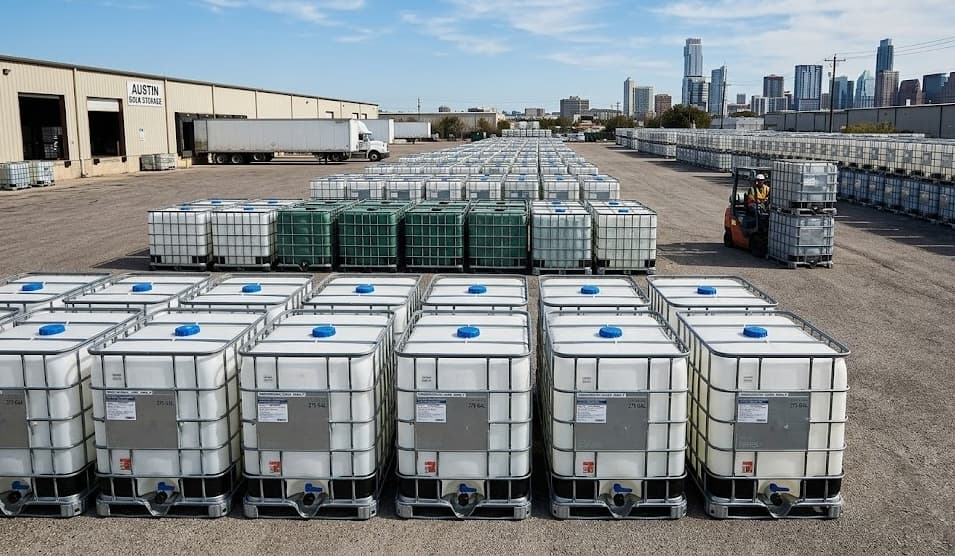
330-Gallon IBC Totes
The 330-gallon IBC maximizes liquid volume on a single pallet position. With roughly 20% more capacity than the standard 275-gallon unit on the same footprint.
Dimensions & Specifications
Physical Dimensions
Construction Details
275-Gallon vs. 330-Gallon
Both sizes share the same 48 x 40 inch pallet footprint, so they are interchangeable in warehouse racking and truck loading patterns. The key differences are height, weight, and total capacity.
Ideal Applications
The 330-gallon IBC is preferred in applications where maximizing volume per pallet position directly reduces cost or complexity. The extra height is a minor trade-off for a significant gain in payload efficiency.
Pricing Information
330-gallon IBCs are priced slightly above their 275-gallon counterparts due to the additional material in the taller bottle and reinforced cage. However, the cost-per-gallon of storage capacity is actually lower, making the 330-gallon unit the more economical choice for operations that can accommodate the extra 7 inches of height. Available in used (Grade A, B, and C), reconditioned, and new configurations.
Volume discounts begin at 10 units. Full truckload pricing provides the best per-unit cost. Contact our team for a custom quote that reflects current inventory levels and your delivery location.
Detailed Dimension Breakdown
The 330-gallon IBC shares the same pallet footprint as its 275-gallon counterpart but stands 7 inches taller. This extra height is where the additional 55 gallons of capacity comes from. Here is a detailed measurement reference.
External Dimensions (with cage and pallet)
Spatial Planning Reference
The 330-gallon IBC has the same rectangular footprint as the 275-gallon model — the additional capacity comes entirely from the extra 7 inches of height. Picture a box that reaches roughly waist-to-chest height on an average adult (53 inches). The HDPE bottle is taller and has slightly thicker walls (2.5-3.5 mm vs. 2.0-3.0 mm) to handle the increased hydrostatic pressure from the additional liquid column height.
The cage is reinforced with heavier-gauge steel at the top frame to accommodate the higher stacking loads created by the heavier filled unit above. From the outside, the 330-gallon IBC looks identical to the 275-gallon except for the taller profile — all handling equipment, valves, and accessories are interchangeable between the two sizes.
Did You Know?
Switching from 275-gallon to 330-gallon IBCs delivers a 20% increase in storage capacity using the same warehouse floor space. For a company storing 100 pallets of liquid, that means the equivalent of 20 additional pallets of product — without expanding your facility or adding racking. The only requirement is that your vertical clearance can accommodate the extra 7 inches per tier.
Weight Charts: Empty & Filled
The 330-gallon IBC holds approximately 20% more liquid than the 275-gallon model, which increases the gross weight proportionally. Verify your handling equipment and floor ratings can accommodate these weights.
*Entries marked with an asterisk exceed the standard max gross weight rating of 2,900 lbs for most 330-gallon IBCs. When storing liquids heavier than water, reduce fill volume to stay within the weight rating, or verify your specific IBC model's maximum gross weight with the manufacturer. Never exceed the rated gross weight — it compromises stacking safety and may void the UN/DOT certification.
Stacking Guidelines
330-Gallon Stacking Considerations
The taller 330-gallon IBC requires more attention to stacking clearances than the standard 275-gallon size. While it is still rated for 2-high loaded stacking, the combined height of two stacked 330-gallon IBCs reaches 106 inches (8.83 feet) — compared to 92 inches (7.67 feet) for 275-gallon units. This 14-inch difference matters in trailers, racking, and under-ceiling operations.
- - Verify trailer interior height before shipping 2-high (minimum 108 inches recommended)
- - Check warehouse racking beam heights accommodate 53 inches per tier plus clearance
- - Sprinkler head clearance: maintain required 18-inch clearance below fire sprinklers
- - Forklift mast height must reach the top of a 2-high stack (106+ inches) safely
- - In low-ceiling spaces, consider single-tier storage of 330-gallon vs. 2-tier 275-gallon
Stacking Height Comparison
Did You Know?
When shipping 330-gallon IBCs 2-high in a standard 53-foot dry van, you have only about 4 inches of clearance between the top of the upper IBC and the trailer ceiling. While this technically fits, any uneven loading, road vibration, or slight misalignment during stacking can cause contact with the ceiling. Some carriers require air-ride suspension trailers for 2-high 330-gallon shipments to minimize bounce.
Explore Related Products
275-Gallon IBCs
Standard size — universal compatibility
Used IBC Totes
Graded and inspected 330-gallon options
Reconditioned IBCs
Triple-washed with 90-day guarantee
New IBC Tanks
Brand-new 330-gallon from top brands
Food-Grade IBCs
FDA-compliant for food and beverage
IBC Accessories
Valves, gaskets, heaters, and more
Custom Solutions
Modified 330-gallon configurations
IBC Knowledge Base
Guides and industry resources
Frequently Asked Questions
How much does a 330-gallon IBC weigh when full of water?
Can I use 275-gallon accessories on a 330-gallon IBC?
Will 330-gallon IBCs fit in my warehouse racking?
Is the 330-gallon IBC more cost-effective than the 275-gallon?
Are 330-gallon IBCs available in food-grade?
Order 330-Gallon IBC Totes
Available at 1405 Worldwide Blvd, Hebron, KY 41048 or delivered to your facility.