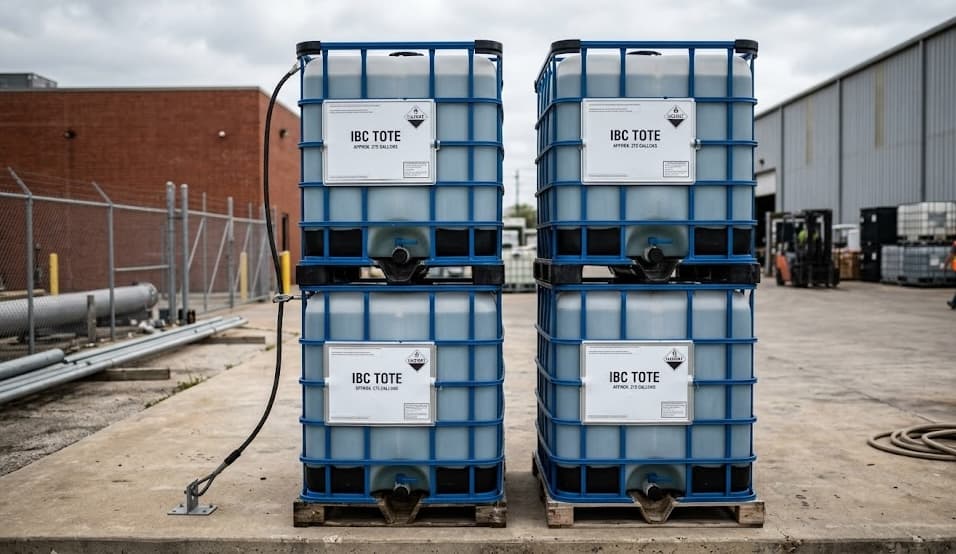
Food-Grade IBC Totes
When your product enters the human food chain, the container that carries it must meet the highest standards of cleanliness, material safety, and traceability.
FDA Compliance
All food-grade IBCs we supply are manufactured from high-density polyethylene (HDPE) resin that complies with FDA 21 CFR 177.1520 — the federal regulation governing olefin polymers intended for food-contact use. This means the plastic itself has been tested and certified safe for direct contact with food products, including oils, juices, syrups, sauces, and dry ingredients.
For reconditioned food-grade IBCs, we go further. Only containers that originally held food-grade, pharmaceutical, or cosmetic materials are eligible for food-grade reconditioning. We verify the previous contents through manifest documentation and original labeling before any container enters our food-grade wash line. This strict chain-of-custody approach ensures that no container with a history of industrial chemicals, solvents, or hazardous materials is ever introduced into the food-grade reconditioning stream.
Kosher Certification
For customers in the kosher food supply chain, we offer IBC totes processed under rabbinical supervision to meet kosher certification standards. Our kosher reconditioning process uses segregated wash equipment, kosher-approved cleaning agents, and dedicated storage areas to prevent any cross-contact with non-kosher materials.
Each kosher-certified IBC ships with documentation from the supervising rabbinical authority confirming that the container was processed in accordance with applicable kosher laws. This certification is essential for food manufacturers, ingredient suppliers, and distributors whose products carry kosher certification and require compliant packaging throughout the supply chain.
Kosher Process Highlights
- - Dedicated wash line separate from non-kosher containers
- - Kosher-approved detergents and sanitizing agents
- - Rabbinical supervision during processing
- - Segregated staging and storage areas
- - Individual certification documentation per unit
- - Available for both 275-gallon and 330-gallon IBCs
Clean-Room Standards
Our food-grade reconditioning area at 1405 Worldwide Blvd, Hebron, KY operates under controlled environmental conditions designed to minimize airborne contamination. The space features positive air pressure to prevent outside particulate ingress, sealed flooring with coved wall junctions for easy cleaning, and temperature and humidity monitoring to maintain conditions suitable for food-contact container processing.
After reconditioning, food-grade IBCs are immediately fitted with tamper-evident dust covers and sealed caps to protect both the fill opening and discharge valve from contamination during storage and shipping. Containers are stored in the clean staging area — separated from industrial-grade inventory — until they are loaded for delivery. This end-to-end environmental control ensures the container arrives at your facility in the same hygienic condition it left ours.
Food & Beverage Applications
Our food-grade IBCs serve a broad range of applications across the food, beverage, and related industries. Here are the most common use cases:
Ordering Food-Grade IBCs
New Food-Grade
Brand-new HDPE IBCs from certified manufacturers, never previously filled. The optimal choice for products with strict first-use-only packaging requirements, pharmaceutical applications, and premium food brands where consumer confidence in packaging integrity is paramount. Available in 275 and 330 gallon sizes with your choice of pallet type and valve configuration.
Reconditioned Food-Grade
Previously used containers that have been through our full food-grade reconditioning process: triple wash, pressure test, new valves and gaskets, clean-room storage. Ideal for applications where cost efficiency matters and a documented reconditioning process meets your quality requirements. Ships with a Certificate of Reconditioning and optional microbiological test results.
FDA Regulation Deep-Dive
21 CFR 177.1520: What It Actually Covers
FDA 21 CFR 177.1520 governs olefin polymers — including HDPE — intended for use in contact with food. The regulation specifies allowable resin formulations, additive limits, and extraction testing requirements that the plastic must meet before it can be legally used as a food-contact surface.
Compliance with 21 CFR 177.1520 means the HDPE resin itself is safe for food contact. However, this regulation applies to the raw material — it does not automatically make a used or reconditioned container food-safe. The condition of the container, its previous contents, the cleaning process, and storage conditions all factor into whether a specific IBC is suitable for food-grade use.
For new IBCs, food-grade certification is provided by the manufacturer based on the resin lot and production process. For reconditioned IBCs, food-grade status depends on the documented reconditioning process — which is why our triple-wash, pressure-test, and certification protocol is so important.
Key FDA Regulations for IBC Users
- -21 CFR 177.1520: Olefin polymers for food contact — governs the HDPE resin material
- -21 CFR 174.5: General provisions for indirect food additives — covers substances that may migrate from packaging into food
- -21 CFR 110: Current Good Manufacturing Practice (cGMP) — establishes conditions for manufacturing, packing, and holding food
- -FSMA (Food Safety Modernization Act): Requires preventive controls, including sanitary transport of food — affects how food-grade IBCs are handled and shipped
- -21 CFR 1.361-1.368: Sanitary Transportation of Human and Animal Food — governs temperature control, cross-contamination prevention, and vehicle cleanliness during transport
Did You Know?
The FDA does not “certify” or “approve” individual containers for food contact. Instead, it establishes regulations that materials must comply with. When we say an IBC is “FDA compliant,” we mean the materials and processes used meet the requirements of the applicable CFR sections. The responsibility for ensuring compliance rests with the manufacturer (for new containers) and the reconditioner (for reconditioned containers). This is why choosing a reputable supplier with documented processes is critical for food safety.
Cleaning Protocol Comparison
Not all IBC cleaning is created equal. Here is how our food-grade reconditioning process compares to basic rinse methods and industrial cleaning.
Contamination Prevention
Our Multi-Layer Contamination Prevention
Preventing contamination is not a single step — it is a layered system of controls that begins when a used IBC arrives at our facility and ends only when the reconditioned container is sealed and delivered to your dock. Here is how we ensure food-grade integrity at every stage.
- 1. Source verification: Only IBCs with documented food-grade, pharmaceutical, or cosmetic previous contents enter the food-grade line
- 2. Physical separation: Food-grade wash area is completely separated from industrial wash operations
- 3. Dedicated equipment: Wash nozzles, hoses, and pumps used for food-grade are never used for industrial containers
- 4. Controlled environment: Positive air pressure, sealed flooring, temperature and humidity monitoring
- 5. New components only: Every valve, cap, and gasket is replaced with new, food-grade-certified components
- 6. Tamper-evident sealing: Dust covers and sealed caps applied immediately after reconditioning
- 7. Segregated storage: Food-grade containers stored in dedicated clean staging area until shipment
Common Contamination Risks We Prevent
- - Chemical cross-contamination: Residual industrial chemicals from previous use — eliminated by source verification and triple washing
- - Microbiological contamination: Bacteria, mold, and yeast — eliminated by high-temperature sanitizing and clean-room storage
- - Physical contamination: Debris, label fragments, rust particles — eliminated by full disassembly, de-labeling, and visual inspection
- - Allergen cross-contact: Residual allergens from previous food products — addressed by documenting previous contents and thorough washing
- - Odor absorption: HDPE absorbing odors from previous contents — addressed by triple washing with hot alkaline solution
Did You Know?
HDPE is a semi-porous material at the molecular level. While it appears smooth and solid, certain chemicals — especially aromatic compounds and strong flavors — can absorb into the plastic surface and later leach out into a new product. This is why we only allow IBCs with verified food-grade, pharmaceutical, or cosmetic histories into our food-grade line. An IBC that previously held an industrial solvent can never be made truly food-safe, no matter how many times it is washed.
Record-Keeping Requirements
What Records We Maintain
Food safety auditors and regulatory inspectors expect comprehensive documentation for any container that contacts food products. We maintain detailed records for every food-grade IBC that passes through our reconditioning process, and we make this documentation available to customers upon request.
- - Previous contents identification and source documentation
- - Original manufacturer and manufacture date
- - Reconditioning date and technician identification
- - Wash chemistry (detergent type, concentration, lot number)
- - Wash temperatures for each cycle (documented automatically)
- - Pressure test results (pass/fail with pressure readings)
- - Replacement component lot numbers (valve, cap, gaskets)
- - Final QC inspector sign-off
- - Microbiological test results (when requested)
- - Kosher supervision documentation (when applicable)
What You Should Maintain
As the end user, your own record-keeping should complement our reconditioning documentation. FSMA and food safety audit standards expect you to maintain:
- - Certificate of Reconditioning from IBC Cincinnati (we provide this)
- - Date of receipt and receiving inspection results
- - Product filled into each IBC (product name, lot, date)
- - Cleaning records if the IBC is reused between your own products
- - Storage conditions (temperature, location, indoor/outdoor)
- - Disposition records (shipped to customer, returned, retired)
Audit-Ready Documentation
If you undergo SQF, BRC, FSSC 22000, or other food safety audits, your auditor will likely ask about your packaging supplier's qualifications. We provide audit-support documentation packages that include our reconditioning SOPs, quality management system overview, cleaning chemistry safety data sheets, and sample Certificates of Reconditioning. Request an audit support package when placing your order.
Explore Related Products & Resources
Reconditioned IBCs
Our full reconditioning process explained
New IBC Tanks
First-use containers for sensitive products
Used IBC Totes
Budget-friendly for non-food applications
IBC Accessories
Food-grade gaskets, valves, and liners
Custom Solutions
Food-grade systems and modifications
275-Gallon IBCs
Standard size food-grade containers
330-Gallon IBCs
Large-volume food-grade containers
IBC Knowledge Base
Food safety guides and best practices
Frequently Asked Questions
Can a used IBC that previously held chemicals be reconditioned to food-grade?
Do food-grade IBCs come with microbiological test results?
What is the difference between food-grade new and food-grade reconditioned?
Are your food-grade IBCs suitable for organic products?
How should I store food-grade IBCs before use?
Can I get halal-certified IBCs?
Need Food-Grade IBCs?
Contact IBC Cincinnati at 1405 Worldwide Blvd, Hebron, KY 41048 for food-grade availability, kosher certification options, and custom documentation requirements.