Food & Beverage

Food & Beverage Industry IBCs

When your product enters the human food chain, the container that carries it must meet the highest standards of material safety, cleanliness, and regulatory traceability.

Free Quote

Request a Quote

Tell us who you are

Compliance & Certifications

Food-grade IBC containers are not just cleaned containers — they are containers with verified material composition, documented contents history, validated cleaning protocols, and certification from recognized regulatory and religious authorities.

FDA 21 CFR 177.1520

The federal regulation governing olefin polymers for food-contact use. Every HDPE bottle in our food-grade IBCs is manufactured from virgin resin that meets this standard. For reconditioned containers, we verify that the original bottle was produced under this regulation and has not been compromised by incompatible prior contents. Our documentation includes the resin manufacturer certificate and original container production records when available.

Kosher Certification

Our kosher reconditioning process operates under rabbinical supervision with a dedicated wash line, kosher-approved cleaning agents, and segregated storage. Each kosher-certified IBC ships with documentation from the supervising rabbinical authority. This certification is essential for food manufacturers, ingredient suppliers, and distributors whose products carry kosher labels and require compliant packaging throughout the supply chain.

Halal Certification

For customers in the halal food supply chain, we offer containers processed in accordance with halal requirements. This includes verification that no haram substances were previously stored in the container, dedicated cleaning equipment, and halal-compliant processing documentation. Halal certification is increasingly required by food manufacturers serving Muslim-majority export markets.

HACCP Compatibility

Our food-grade reconditioning facility operates with Hazard Analysis Critical Control Point principles integrated into every process stage. We identify potential biological, chemical, and physical hazards at each step — intake inspection, wash, rinse, sanitize, dry, assemble, store — and maintain critical control point monitoring records that your HACCP auditors can review on request.

FDA Inspection Preparation Checklist

FDA inspections of food manufacturing and processing facilities can happen at any time — and your IBC containers will be examined. Use this 15-point checklist to ensure your container program is audit-ready before an inspector arrives.

01

Verify FDA 21 CFR 177.1520 compliance documentation is on file for every food-grade IBC currently in use

02

Confirm Certificate of Conformance (CoC) is available for each reconditioned container batch

03

Ensure resin manufacturer certificates are archived and traceable to specific container lots

04

Validate that all food-contact IBCs are clearly labeled with food-grade identification markings

05

Review cleaning validation records — verify wash temperature logs show 160°F minimum consistently

06

Confirm sanitizer concentration records meet EPA-registered food-contact sanitizer requirements

07

Inspect all containers for physical defects: cracks, discoloration, warping, or residue build-up

08

Verify valve, gasket, and cap replacement records — all food-contact components must be new

09

Check container segregation — food-grade IBCs must be stored separately from chemical-grade and used containers

10

Ensure contents history documentation is complete for all reconditioned containers — no gaps in chain of custody

11

Verify that your IBC supplier (IBC Cincinnati) is qualified in your Approved Supplier List with current documentation

12

Review pest control records for IBC storage areas — containers must be stored in a clean, pest-free environment

13

Confirm allergen cross-contamination prevention protocols are documented and followed for IBCs that held allergenic ingredients

14

Ensure water quality records for rinse water meet EPA potable water standards for food-contact surface rinsing

15

Have your HACCP plan updated to include IBC container handling as a critical control point with monitoring procedures

Pro Tip: IBC Cincinnati provides a complete FDA-ready documentation package with every food-grade container shipment. When your inspector asks for proof of packaging compliance, you will have the Certificate of Conformance, cleaning validation records, resin certificates, and chain-of-custody documentation ready and organized. Learn more about our certifications.

Common FDA Violations & How to Avoid Them

Every year, hundreds of food facilities receive FDA warning letters and 483 observations related to container and packaging compliance. Here are the most frequent violations related to IBC containers and how IBC Cincinnati helps you avoid each one.

ViolationFDA CitationFrequencyPotential PenaltyHow We Prevent It
Non-food-grade containers used for food products21 CFR 117.35(a)Very CommonWarning letter, product recallEvery IBC ships with FDA compliance documentation and food-grade labeling
Missing or incomplete container cleaning records21 CFR 117.35(d)CommonForm 483 observationFull cleaning validation records with timestamps at every stage
Containers with visible residue or contamination21 CFR 117.35(a)CommonProduct seizure, injunctionFinal QC inspection with documented pass/fail before shipment
No allergen cross-contamination prevention for containers21 CFR 117.135IncreasingProduct recall, $250K+ finesAllergen tracking in contents history, dedicated wash protocols
Reused containers without validated reconditioning21 CFR 177.1520CommonWarning letter, consent decreeISO-aligned reconditioning with validated wash, rinse, sanitize cycle
Inadequate supplier qualification for container vendors21 CFR 117.410ModerateForm 483, audit failureComplete supplier qualification package provided upon request
Container storage in unsanitary conditions21 CFR 117.35(c)CommonWarning letterContainers shipped with protective dust covers, storage guidance provided
Missing traceability from container to product batch21 CFR 117.305ModerateRecall complicationsUnique serial numbers and batch tracking for full traceability

Did You Know? According to FDA enforcement data, container and packaging-related violations appear in approximately 12% of all food facility Form 483 observations. Proactive container compliance is one of the most cost-effective ways to reduce your FDA audit risk.

Temperature Control Requirements by Product Type

Proper temperature management is critical for food-grade IBC containers. Different product categories require different storage and transport temperature ranges to maintain product integrity, prevent spoilage, and comply with food safety regulations.

Product CategoryStorage TempTransport TempMax Exposure Time (Ambient)IBC Considerations
Edible Oils60-75°F55-80°F72 hoursUV-protected storage; avoid freezing (solidification risk)
Juice Concentrates32-40°F32-45°F4 hoursRefrigerated transport required; insulated IBC covers recommended
Syrups & Sweeteners65-85°F60-90°FIndefinite (shelf-stable)Heated IBC blankets for cold-weather dispensing
Dairy Products33-38°F33-40°F2 hoursCold chain critical; temperature logging required
Wine & Beer50-65°F45-70°F24 hoursAvoid temperature cycling; UV protection essential
Sauces (Acidified)50-75°F45-85°F48 hourspH monitoring; HDPE resistant to acidic degradation
Liquid Egg Products33-38°F33-40°F1 hourStrict cold chain; sanitized food-grade only
Chocolate/Cocoa Liquor95-115°F95-120°FN/A — must remain heatedHeated IBC blankets mandatory; solidifies below 90°F
Brewing Adjuncts60-75°F55-80°F48 hoursSanitized containers; cam-lock fittings for brewery systems
Flavoring Extracts60-75°F55-85°F72 hoursFragrance-free containers; dedicated-use recommended

Pro Tip: IBC Cincinnati supplies heated IBC blankets and insulated covers for temperature-sensitive products. Our heated blankets maintain consistent temperature between 100-150°F for products like chocolate, honey, and crystallizing syrups. Contact us for temperature management accessories.

Allergen Cross-Contamination Prevention

The FDA's Food Safety Modernization Act (FSMA) requires food facilities to implement preventive controls for allergen cross-contact. For IBC containers, this means rigorous tracking of previous contents and validated cleaning protocols that eliminate allergenic residues. Here is how IBC Cincinnati addresses the top 9 major food allergens in our container reconditioning process.

AllergenCommon IBC ProductsCleaning ProtocolVerification MethodDocumentation
Milk/DairyCream, whey, buttermilk, casein solutionsHot alkaline wash + acid rinse + sanitizeLateral flow allergen test stripAllergen test certificate per container
SoySoybean oil, soy sauce, soy lecithinTriple hot water rinse + alkaline washELISA-validated swab testCleaning validation + allergen clearance
Tree NutsAlmond oil, walnut oil, hazelnut extractDedicated wash cycle + extended rinseAllergen-specific lateral flow testContents history + allergen-free cert
PeanutPeanut oil, peanut butter slurryHot caustic wash + triple rinse + sanitizePeanut-specific ELISA at <10 ppmLab test results + cleaning records
Wheat/GlutenLiquid malt extract, wheat starch slurryExtended alkaline wash + acid neutralizationGluten-specific test at <20 ppmGluten-free validation certificate
EggLiquid egg, egg white solutions, egg yolkHot caustic wash + enzyme cleaner + sanitizeEgg protein lateral flow testAllergen clearance documentation
FishFish oil, fish sauce, omega-3 concentratesDedicated-use containers recommendedVisual + odor inspection + swab testDedicated-use tracking records
ShellfishShrimp extract, crab flavoringDedicated-use containers recommendedShellfish-specific allergen testDedicated-use tracking records
SesameSesame oil, tahiniHot alkaline wash + triple rinseSesame-specific lateral flow testAllergen test certificate per lot

Did You Know? Sesame was added as the 9th major food allergen in the United States effective January 1, 2023 under the FASTER Act. Many IBC reconditioning companies have not yet updated their allergen tracking systems to include sesame. IBC Cincinnati tracks sesame as a major allergen in all container contents histories, ensuring your containers are FASTER Act compliant.

Pro Tip: For products containing major allergens, consider requesting dedicated-use IBCs that only circulate within your allergen-specific product line. IBC Cincinnati offers color-coded valve caps and serial-numbered tracking for dedicated allergen containers, making cross-contamination prevention auditable and verifiable.

Products Stored in Food-Grade IBCs

Our food-grade IBC totes serve a broad spectrum of applications across the food and beverage supply chain. Here are the most common product categories and their specific container requirements.

Edible Oils

Vegetable, canola, olive, coconut, palm, and sunflower oils stored and shipped in bulk. IBCs with 2-inch butterfly valves are standard for oil dispensing lines.

Juice Concentrates

Orange, apple, grape, and tropical fruit concentrates require containers with zero residual taste or odor transfer. Our triple-wash protocol eliminates any trace of previous contents.

Syrups & Sweeteners

High-fructose corn syrup, maple syrup, honey, and agave nectar are viscous liquids that demand wide-opening IBCs and heated storage options to maintain flow characteristics.

Sauces & Condiments

Hot sauce, soy sauce, vinegar, dressings, and marinades — acidic products that require HDPE bottles resistant to pH-related degradation over extended storage periods.

Wine & Brewing

Wineries and craft breweries use IBCs for bulk wine transport, brewing adjuncts, and liquid yeast. Containers must be sanitized to prevent microbial contamination of fermentation processes.

Dairy Products

Liquid cream, milk concentrates, whey protein, and buttermilk require refrigerated storage and containers that have been sanitized to dairy industry SSOP standards.

Food-Grade IBC Market Statistics

The food and beverage industry is the single largest consumer of IBC containers globally. Understanding these market numbers helps food businesses benchmark their container spending and identify optimization opportunities.

$921M

Food IBC Market Size (2024)

4.2M

Annual Units (US Market)

7.4%

Annual Growth Rate (CAGR)

28%

Share of Total IBC Market

Food Sub-SectorIBC Usage ShareAvg. Annual IBCs (Mid-Size)Typical Reconditioned SavingsGrowth Trend
Edible Oils & Fats22%300-50055%Stable growth
Juice & Beverage Concentrates18%200-40052%Strong growth
Syrups & Sweeteners16%250-45058%Moderate growth
Dairy Ingredients14%150-30048%Strong growth
Sauces, Dressings & Condiments12%100-25054%Strong growth
Wine, Beer & Spirits10%50-20060%Rapid growth
Flavoring & Extracts5%50-15050%Moderate growth
Other Food Ingredients3%25-10056%Stable

Cleaning Requirements

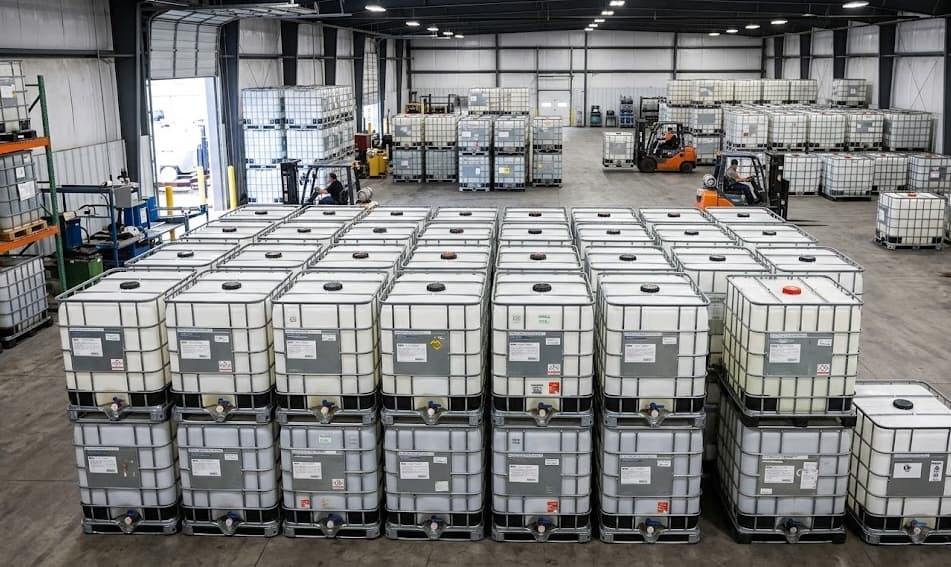
Food-grade reconditioning at our 1405 Worldwide Blvd, Hebron, KY 41048 facility follows a multi-stage protocol that goes far beyond a simple rinse. Every container passes through a hot alkaline wash at 160 degrees F to break down organic residues, followed by a high-pressure fresh water rinse to remove all detergent traces, then a food-safe sanitizing treatment to eliminate microbial contamination.

After sanitization, containers are air-dried in our controlled-environment staging area using filtered air to prevent recontamination. New food-grade valves, gaskets, and tamper-evident caps are installed before final inspection. Each unit is pressure-tested to verify seal integrity, then fitted with protective dust covers for storage and transport.

The entire process is documented with timestamps, temperature readings, and operator identification at each stage. This documentation travels with the container and is available to your quality assurance team for HACCP, SQF, BRC, or any other food safety audit framework your operation follows.
Cleaning Process Steps

01

Contents history verification and manifest review

02

External cage and pallet inspection and cleaning

03

Hot alkaline interior wash at 160°F minimum

04

High-pressure fresh water triple rinse

05

Food-safe sanitizer application and dwell time

06

Filtered air drying in controlled environment

07

New valve, gasket, and cap installation

08

Pressure test and final quality inspection

Industry Case Studies

Regional Edible Oil Processor

A Cincinnati-area edible oil processor was purchasing new IBCs exclusively, spending over $180 per container. After switching to our food-grade reconditioned IBCs at $85 per unit, they reduced their container costs by 53% while maintaining full FDA compliance. We supply them with 200 units per month on a scheduled delivery program, each container arriving with food-grade certification, new butterfly valves, and tamper-evident seals. Their quality team confirmed zero contamination incidents over 18 months of use.

53% Cost Reduction200 Units/MonthZero Incidents

Kosher Ingredient Distributor

A kosher food ingredient distributor based in Kentucky needed containers that satisfied their rabbinical authority requirements. Previous suppliers could not provide containers with documented kosher cleaning protocols. We established a dedicated kosher reconditioning line with rabbinical oversight, segregated equipment, and kosher-approved cleaning agents. Today we supply their entire container fleet — 75 units per month — with individual kosher certification documentation that passes their annual audit without exception.

Kosher Certified75 Units/MonthFull Audit Compliance

Craft Brewery Expansion

A growing craft brewery in Ohio needed a cost-effective way to receive bulk brewing adjuncts — liquid malt extract, hop oils, and flavoring compounds — without investing in fixed tank infrastructure. We supplied sanitized food-grade IBCs with cam-lock fittings compatible with their existing transfer pumps. The brewery scaled from 5 to 25 IBCs per month as production grew, with each container returned to us for reconditioning and reuse in a closed-loop system that reduced their packaging waste by over 80%.

5x Volume Growth80% Waste ReductionClosed-Loop System

Food & Beverage IBC FAQ

Can reconditioned IBCs safely hold food-grade products?

Yes, when properly reconditioned. Our food-grade reconditioning process includes contents history verification, hot alkaline wash at 160°F minimum, triple fresh-water rinse, food-safe sanitization, new valve and gasket installation, and pressure testing. Every food-grade reconditioned IBC ships with a Certificate of Conformance and cleaning validation records that satisfy FDA, SQF, BRC, and HACCP audit requirements. Over 18 months of customer use, we have recorded zero contamination incidents with our food-grade reconditioned containers.

How do you prevent allergen cross-contamination between containers?

We track the complete contents history of every container that enters our facility. Containers that previously held major allergens (milk, soy, nuts, wheat, egg, fish, shellfish, peanuts, sesame) are identified, cleaned using allergen-specific protocols with validated rinse and sanitize cycles, and tested using lateral flow allergen test strips or ELISA methods to verify allergen removal below detectable thresholds. For high-risk allergen applications, we recommend dedicated-use containers with serial-number tracking.

What temperature monitoring is available for food-grade IBCs?

We supply heated IBC blankets (100-150°F range) for products that require temperature maintenance during storage and transport, insulated IBC covers for cold-chain products, and temperature data loggers that can be attached to individual containers for full cold-chain documentation. For dairy and perishable applications, we can coordinate refrigerated transport through our logistics partners.

Do your kosher-certified IBCs satisfy major rabbinical authorities?

Yes. Our kosher reconditioning process operates under direct rabbinical supervision with dedicated wash lines, kosher-approved cleaning agents, segregated storage, and individual container certification. We provide documentation from the supervising rabbinical authority with each kosher container. Our certification has been accepted by OU, OK, Star-K, and other major kosher certifying agencies during customer audits.

What is the shelf life of a food-grade reconditioned IBC?

A properly reconditioned food-grade IBC typically supports 3-5 years of active use or 4-6 fill cycles, whichever comes first. The HDPE bottle retains its food-contact properties throughout this period provided it is not exposed to incompatible chemicals or extreme UV degradation. We recommend replacing food-grade containers after 6 fill cycles or at any sign of discoloration, warping, or surface degradation.

Can you supply IBCs for organic food certification programs?

Yes. Organic food processors require containers that have not been exposed to prohibited substances listed under the USDA National Organic Program (NOP). We verify contents history against NOP prohibited substance lists and provide documentation confirming that our cleaning agents are NOP-compliant. For certified organic operations, we can designate containers as organic-dedicated with separate tracking and storage.

Food-Grade IBCs Ready to Ship

Contact IBC Cincinnati for FDA-compliant, kosher-certified IBC totes built for the food and beverage industry. New and reconditioned options available with full documentation.